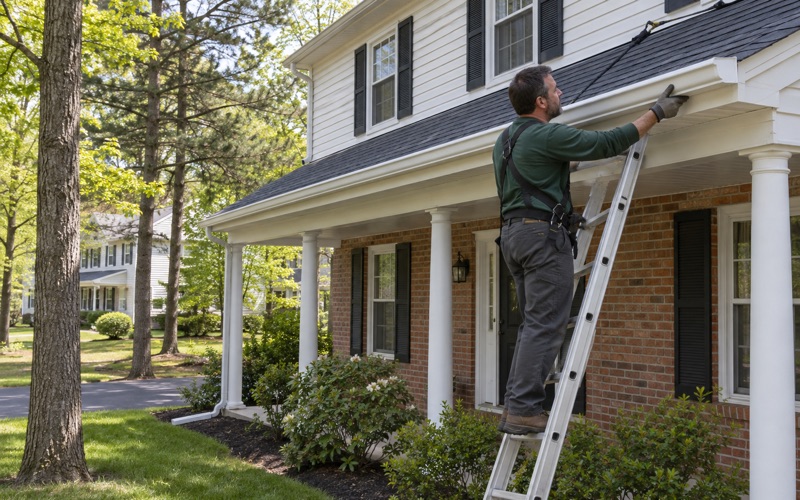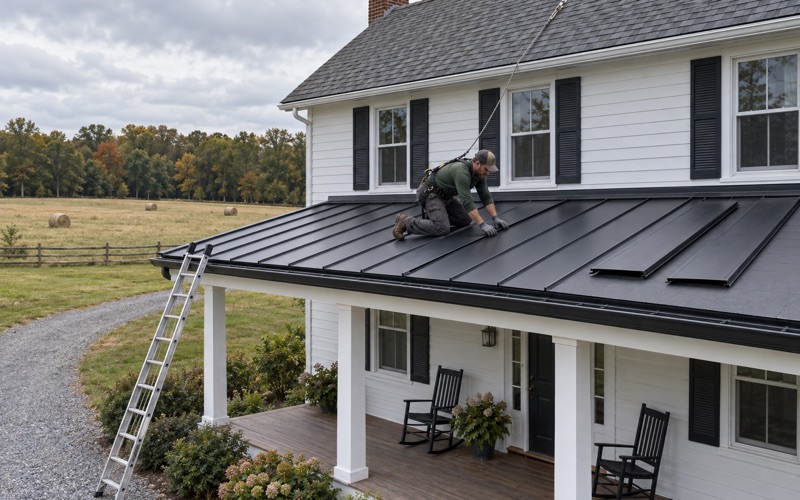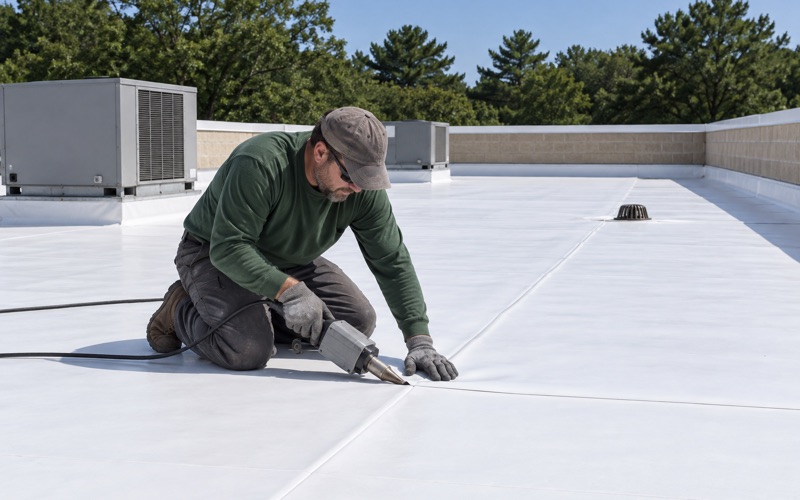
Howell Quality Roofing brings more than 20 years of roofing in West Freehold to every call, whether the problem is one stain on a bedroom ceiling or a roof that has simply reached the end of its run. Before anyone talks about tearing anything off, we tell you plainly whether the roof can be repaired, and only then does replacement come up.
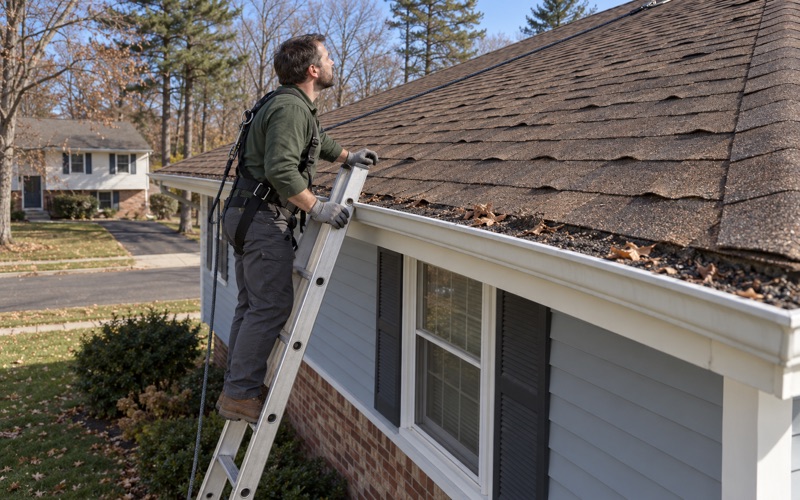
A leak call here always includes a trip into the attic as well as up the ladder. Water rarely drips where it enters, so we follow it back to the spot where it actually gets in before we put a price on fixing it. That one habit saves owners from paying for a repair aimed at the wrong place.
Some owners we meet are also weighing whether a county program could help pay for the work. This page covers how we approach roofs on these houses, what Monmouth County’s repair program says about roofs, and how a county-run job differs from one you hire out yourself.
The Houses Behind West Freehold’s Roofs
Built in the 1960s and 1970s
West Freehold is a census-designated place inside Freehold Township, and its housing leans heavily on two decades. The Census Bureau’s 2024 five-year American Community Survey counts 1,424 homes built in the 1970s and 1,365 built in the 1960s, and 3,201 of the 5,646 housing units here went up before 1980. Stonehurst East and Stonehurst West, the largest neighborhoods, were built mostly in those years on what had been farmland.
The same survey counts 3,327 owner-occupied detached houses. That is a lot of homes whose original roofs are long gone and whose current roofs may be a second or later covering, sitting on decking that has been in place since the house was framed.
What we look for on a roof that age
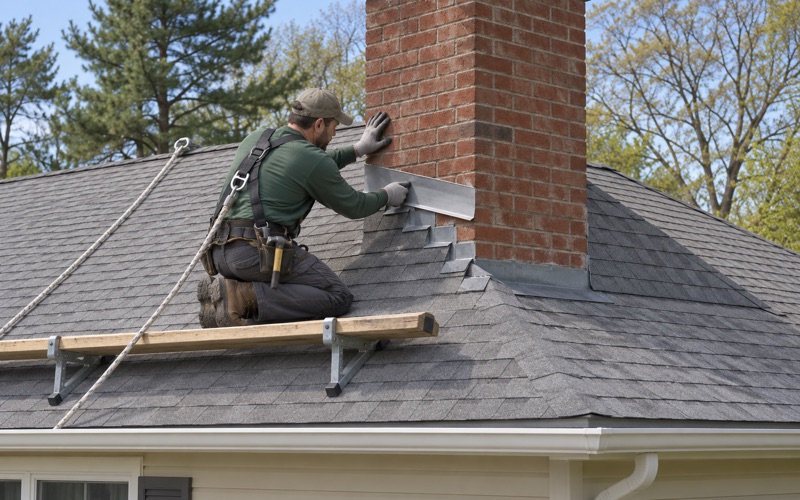
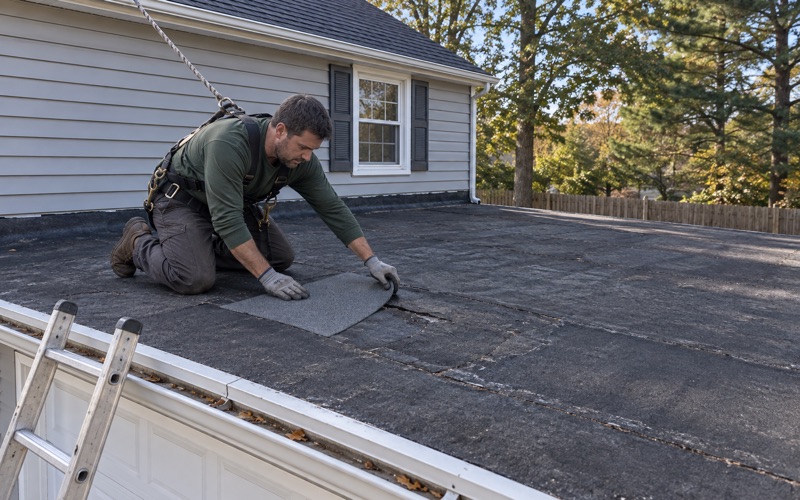
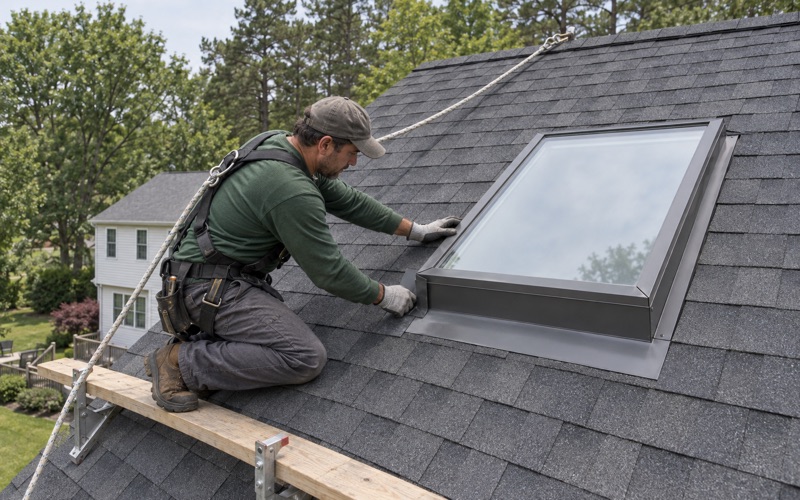
On a house from this era we check how many layers are already on before anything else, because New Jersey’s rehabilitation subcode calls for a tear-off when two or more layers are present. We also look closely at the original decking, the step and counter flashing along any wall, and the chimney, where old flashing is often bent, patched, or sealed over with tar.
Attic ventilation gets the same attention. Houses of this age often show signs of thin soffit intake, and a roof that cannot breathe ages from underneath. On every replacement we check intake and exhaust and plan a ridge vent with soffit intake where the framing allows it.
Repair first, replacement only when it is due
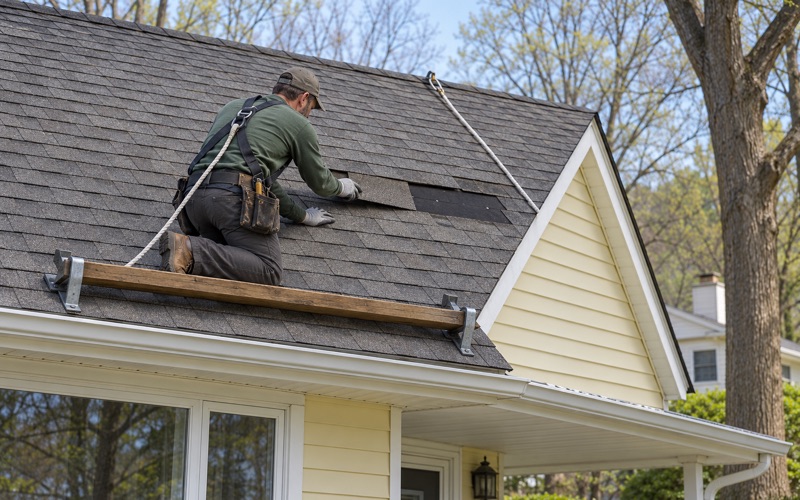
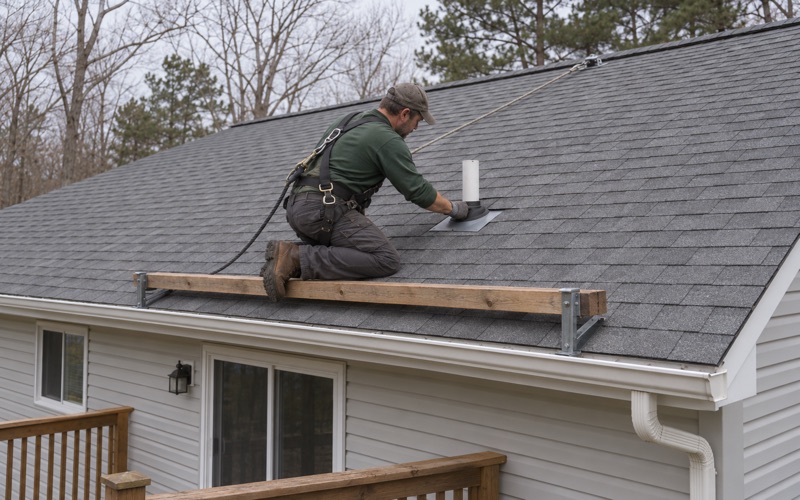
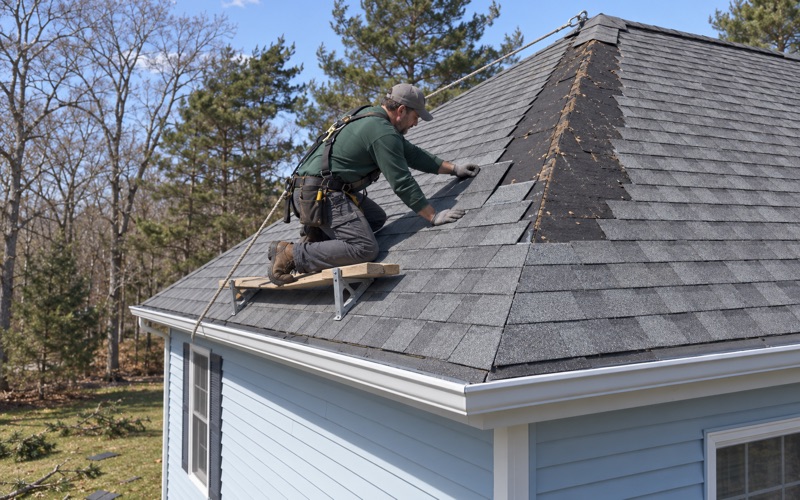
Plenty of leaks on these roofs come from one failed pipe boot, a lifted shingle at the ridge or a loose piece of flashing at a chimney, and those are repairs. When the shingles themselves are curling, losing granules across whole slopes, or soft underfoot over a wide area, patching only buys time. We show you which of those we see and say so in writing.
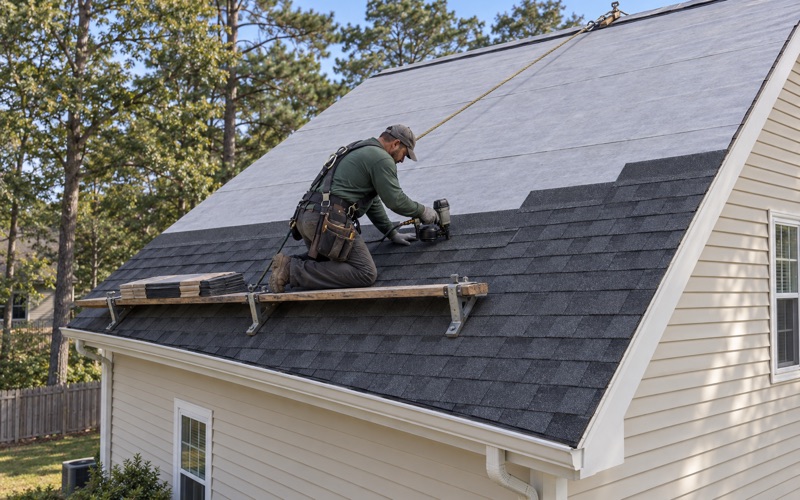
When replacement is the answer, we write it around architectural shingles with a self-adhering ice and water barrier at the eaves and in valleys, synthetic underlayment across the deck, and new drip edge at the eaves and rakes. Every one of those items appears as its own line, so you can see what you are paying for.
Looking for roofing closer to Vista Center? See Roofing Services in Vista Center.
Monmouth County’s Home Repair Program and Roofs
What the program will fund on a roof
The Monmouth County Home Repair Program is run by the county’s Office of Community Development, part of the Division of Planning, from the Hall of Records Annex on East Main Street in Freehold. Its brochure, revised November 2024, sorts eligible work into Major Repairs, Minor Repairs and barrier-free accommodations. Under Major Repairs it names severe roof leaks and damage, with a complete re-roof as the example, and under Minor Repairs it lists a roof patch.
That makes the roof one of the clearest fits for the program. The same brochure excludes items such as siding, painting, trim and driveways, so an application built around a failing roof is easier to read than one built around a wish list.
Older houses and the lead step
Because the program is federally funded, the brochure says any pre-1978 property must be evaluated by a lead risk assessment first, and any lead hazards are addressed with interim controls using lead-safe work practices. Most of West Freehold’s houses predate 1978, so owners here should expect that step and the time it adds before roofing starts.
What the documents leave out
The brochure and the county’s FAQ do not say whether help comes as a grant or a loan, and they state no lien, repayment term or dollar cap. We will not guess at any of those for you. The Office of Community Development, reachable at 732-431-7460 or homerepair@co.monmouth.nj.us, is the place to get that answer in writing before you count on it.
Owners of a duplex should know one more detail. The county program page says only the owner-occupied unit is eligible, except for shared common elements such as a roof or heating unit, so a roof covering both halves can still be part of an application.
Who Qualifies: Income, Ownership and the Seven-Year Rule
Income limits
The program follows HUD low- and moderate-income standards. The income limits in effect from May 1, 2026 are $76,000 for a one-person household, $86,850 for two, $97,700 for three and $108,550 for a family of four, rising to $143,300 for a household of eight. Confirm the figures with the county when you apply, since the table carries its own effective date.
Ownership and occupancy
You must have owned the home and lived in it as your primary residence for at least three years. Second homes, investment properties and vacation homes are excluded, and a house that is listed for sale, under contract or in foreclosure does not qualify. Only owner-occupied units are eligible.
If you bought your house within the last three years, the program is not open to you yet. A leak that cannot wait that long is a job to price and pay for directly, and we can keep the repair small enough to carry the roof until a longer plan makes sense.
Once within a seven-year period
The program helps a household once within a seven-year period, and no more than twice in total. That rule deserves real thought on an older roof. If a patch is approved this year and the whole roof fails three years later, the clock may stand between you and a complete re-roof, which is why an honest read of the roof’s remaining life matters before you apply.
We are glad to look at a roof and tell you whether we see a repair problem or a replacement problem. That opinion is ours alone, though. The county’s own inspection is what sets the work the program will pay for.
How a County Job Is Scoped, Quoted and Awarded
The county writes the scope
Under the county’s FAQ, approval is not an authorization to begin work. A county project manager inspects the house and writes the approved Scope of Work, and the homeowner is not permitted to ask for or negotiate a change in that scope with a contractor. Any roofer pricing the job prices the county’s scope, not a list of extras.
For a roof, that scope can land anywhere from a patch to a complete re-roof, depending on what the project manager finds on the day of the inspection. The review also checks the job against the program’s operating procedures manual and minimum building, zoning and health codes, so the work is held to a written standard from start to finish.
Quotes come from the approved contractor list
The homeowner chooses contractors from the program’s approved contractor list and tells each one the quote is for the Monmouth County Home Repair Program and what work is needed, such as roof repair. Quotes go straight to the project manager, who reviews them against HUD requirements and minimum code, then awards the final contract. A contractor who is not on the list has to apply to become an approved one, so ask the office for the current list before you start calling.
Warranty on a county job
The program requires the contractor to warrant installation labor for at least one year, counted from the completion date on the Completion Certificate. Keep that certificate with your house papers, since it fixes the start of that coverage.
When you hire the roof yourself
Most West Freehold owners will not use the program, and for them the decisions are their own. Our written scopes list tear-off, decking, underlayment, flashing, ventilation and gutters as separate lines, so two bids can be laid side by side and compared item by item. Contracts follow New Jersey’s home improvement rules, including the three-day cancellation notice.
If rotten decking turns up once the old shingles are off, we photograph it and show you before replacing it, at a per-sheet price already written into the contract. Step, counter and chimney flashing are replaced with the roof instead of being reused under new material, and each day ends with the driveway, yard and gutters cleaned and a magnet sweep for nails.
Storms, solar panels and sales
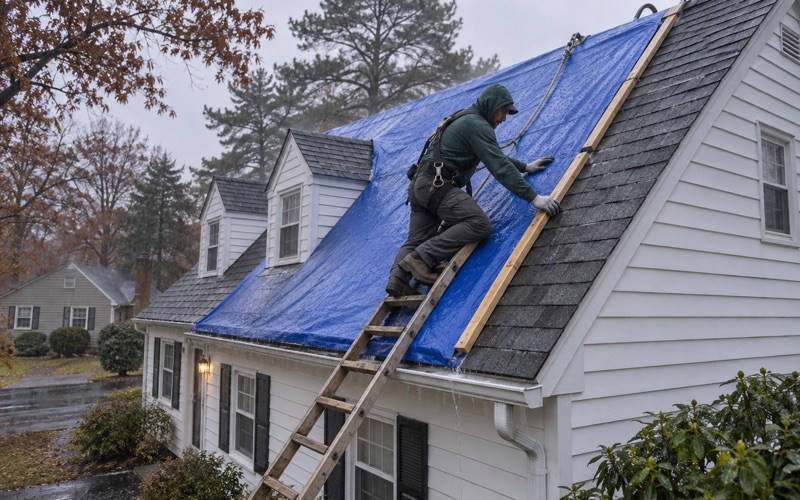
West Freehold sits in the National Weather Service’s Western Monmouth forecast zone, served by the Mount Holly office. After a wind storm we tarp and make temporary repairs the same day, taking photos before anything is moved, and we write the damage up for your own claim. When you ask, our crew will meet the insurance adjuster at the house.
Roofs under solar panels are scheduled with the panel removal and reinstall planned from the start, not discovered on the morning of the job. Owners selling a house can ask for a written roof condition report to hand to the buyer’s inspector, which keeps the roof from becoming a surprise late in the sale.
- 20+ Years on Monmouth County Roofs
- Line-Item Written Estimates
- Same-Day Storm Tarping