Howell Quality Roofing has spent more than 20 years on roofing in Neptune and the rest of Monmouth County, and the first thing we settle on any call here is which part of the township the house sits in. That one detail changes the paperwork, the calendar and the way an estimate has to be written. It does not change how carefully the roof itself gets looked at.
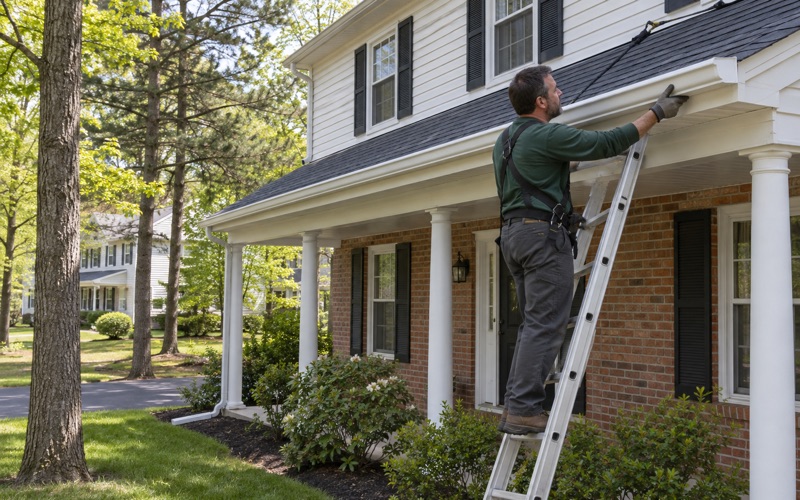
On a leak call we go into the attic as well as onto the roof, because water often shows up a few feet from where it actually enters. Once we know the path, you get a plain answer on whether a repair will hold before anyone mentions a full replacement. Plenty of roofs in the area have years left in them once a failed boot or a loose run of flashing is dealt with.
When replacement is the right call, our written scope breaks the job into separate lines for tear-off, decking, underlayment, flashing, ventilation and gutters. That format lets you set our number beside another contractor’s and compare the work item by item. It also gives a review board something concrete to read, which matters a great deal in one corner of this township.
Ocean Grove Roofs Answer to the Historic Preservation Commission
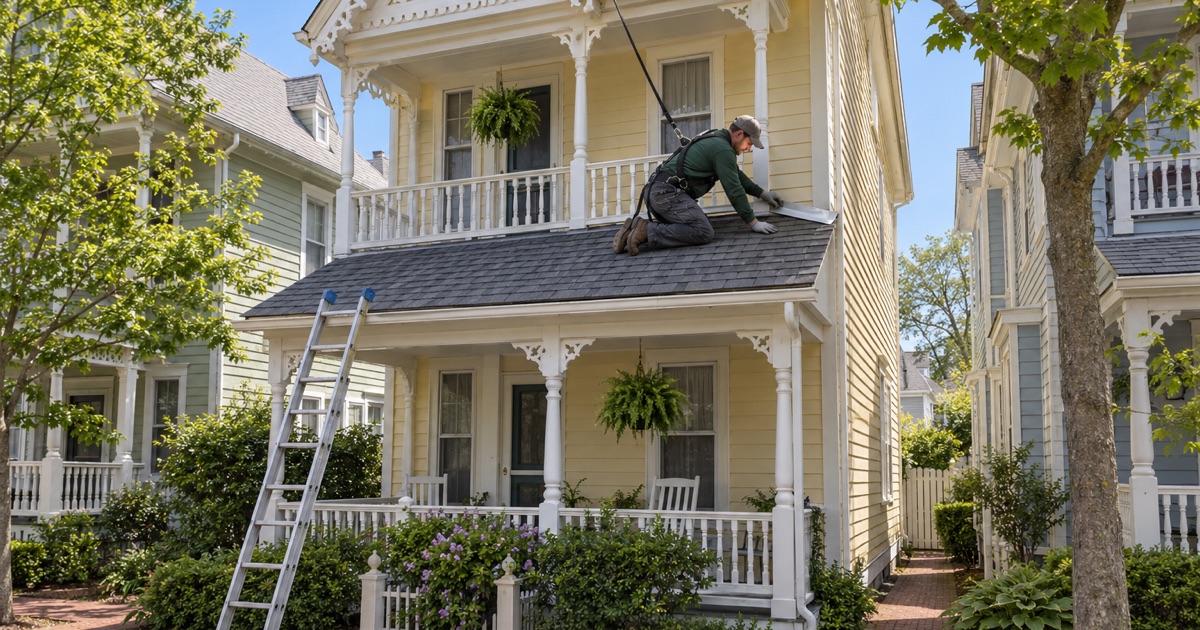
Most of Neptune Township follows the same rules as the rest of the state when a house needs a new roof. Ocean Grove is the exception, because it sits inside a historic district with its own local review board. The Neptune Township Historic Preservation Commission oversees the exteriors of Ocean Grove homes and businesses, and the township says it regulates exteriors only, not interiors.
Why the district has a commission at all
The Ocean Grove Historic District covers about 220 acres and was listed on the National Register of Historic Places in 1976, a few months after the state register listing in December 1975. The commission’s stated mandate is to maintain those designations and preserve the district’s architectural integrity. It has seven regular members and two alternates, all appointed by the mayor.
The houses themselves explain why the review carries weight. Census estimates count 1,784 of the 2,817 housing units in Ocean Grove as built in 1939 or earlier, which is 63.3 percent of the housing stock. Across the whole township the prewar share is closer to one home in five, so the oldest roofs in Neptune are concentrated in a small area.
Roofs and skylights are on the approval list
The township’s commission page tells owners to file an Application for Certificate of Appropriateness before undertaking any work on the exterior of an Ocean Grove residence or business. Roofs and skylights appear on its list of exterior alterations that need commission approval. For a homeowner, that means a re-roof in Ocean Grove is a design review question before it is a scheduling question.
The same page carries a warning that catches people off guard. Many projects that need no zoning, engineering or construction permit may still need approval from the commission. A roof is a good example of exactly that gap, and we plan around it rather than finding it out after the material has been ordered.
A separate step from the state construction code
Under New Jersey’s construction code, re-roofing a detached one- or two-family house is treated as ordinary maintenance, with no construction permit, inspection or notice required (N.J.A.C. 5:23-2.7). That rule holds in Ocean Grove too. The Certificate of Appropriateness is a different thing entirely: a local historic approval that the township applies to exterior work whether or not a construction permit is involved.
Keeping those two apart avoids a common mix-up. An owner who hears that no permit is needed can reasonably assume nothing needs filing, and in Ocean Grove that assumption is wrong. We explain both at the first visit so the timeline you plan around is the real one.
Looking for roofing closer to Spring Lake Heights? See Roofing Services in Spring Lake Heights.
What Goes Into a Certificate of Appropriateness for a Roof
The application packet, last revised in April 2025, is short but specific. The fee is $10, and the township does not accept faxed or emailed applications, so the packet has to be filed directly. What takes time is not the form itself but assembling the supporting material the commission asks to see.
Photographs, narrative and materials
Every application needs a project narrative, color photographs of the existing conditions, a material list, color samples, and catalog cuts or specifications for what will be installed. Our written scope already separates each part of the roof system, so the narrative and the material list come straight from work we have done anyway. We photograph the existing roof from the ground and from the slopes so the commission sees the actual condition.
The packet also says that if the commission is not familiar with a proposed material, samples must be submitted. That is worth knowing early if an owner is considering a product the board may not have reviewed before. We gather manufacturer sheets and physical samples ahead of filing rather than waiting to be asked.
What we do not assume about materials
All exterior work in the district must comply with the standards and intent of the Ocean Grove Historic District Architectural Design Guidelines for Residential Structures, adopted in 2005. We have not read the roofing section of that document, so we will not tell you which materials, colors or profiles the commission prefers. That question belongs to the guidelines and to the commission, and an owner deserves a straight statement of what we know and what we do not.
The packet does state one preference plainly: restoration of original materials and ornamentation is most desirable and highly encouraged. On an older Ocean Grove house that can shape the conversation about trim, cornice details and what gets repaired versus replaced. We raise it with the owner before the scope is finalized.
Skylights, chimneys, gutters and leaders
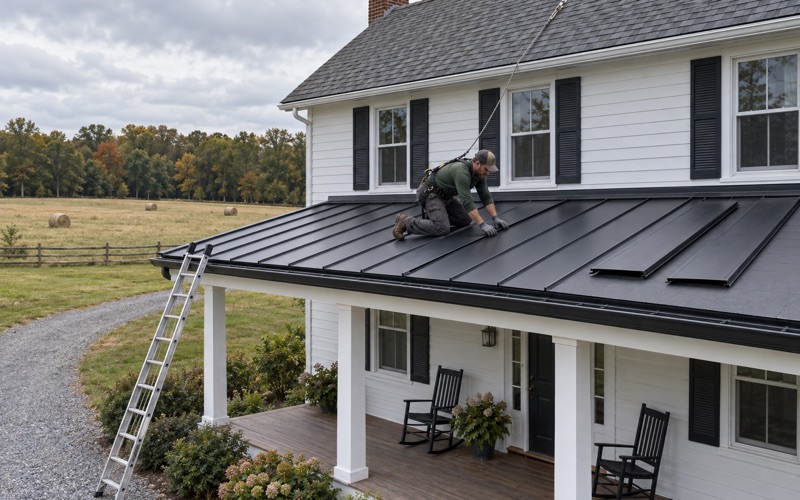
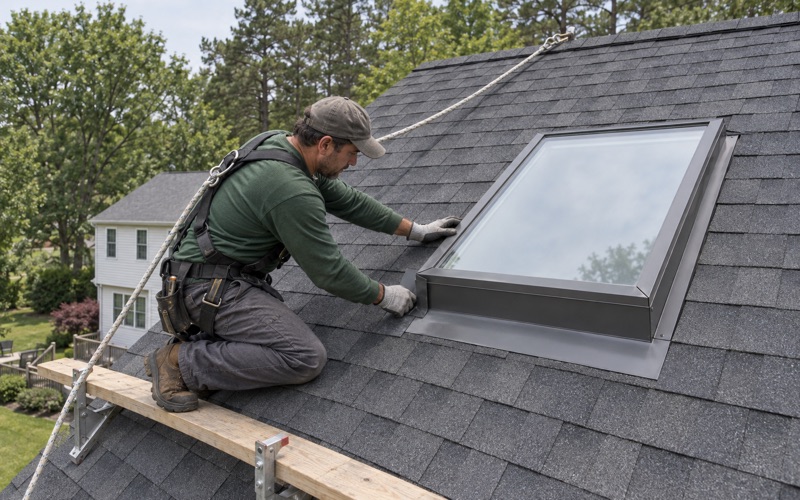
The application form has separate boxes for roof, skylight, chimney, gutters and leaders, solar and vent. A typical replacement touches several of those at once, so we mark each one that applies instead of describing the whole job as a roof. If a skylight is being replaced, a chimney is getting new flashing, or a vent is being added for attic airflow, the commission sees it on the same application.
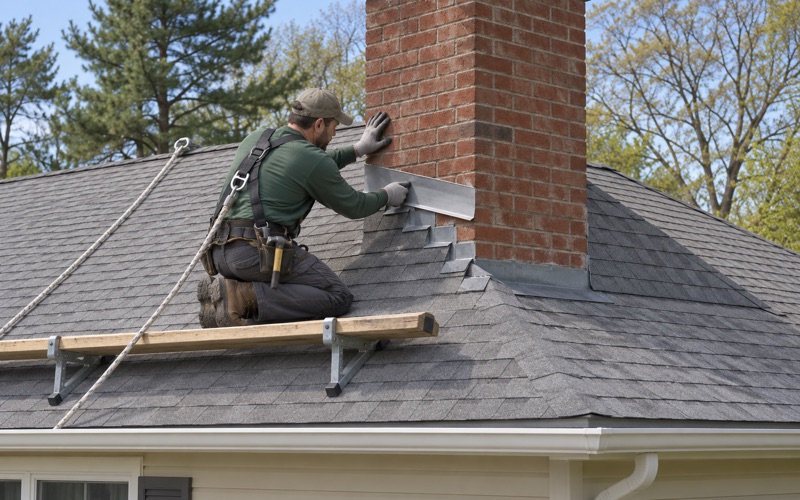
This is where our usual practice lines up neatly with the paperwork. We replace step, counter and chimney flashing with the roof rather than reusing old metal, and we check attic ventilation on every replacement. Listing those items openly on the application means nothing about the finished roof surprises the reviewer later.
Administrative Approval or a Full Hearing
Once an application is in, the township says it will be reviewed and processed within 5 to 10 business days. From there an application may be administratively approved, or it may be directed to the full commission for a hearing. Nobody can promise which path a particular roof will take, and we do not.
Planning the calendar around the review
We build the review window into the schedule from the start. Material orders, crew dates and any coordination with a solar installer are set with the commission’s timeline in mind, not ahead of it. If the application goes to the full board, the full commission meets at 7 p.m. on the second Tuesday of each month in the Township Meeting Room at 25 Neptune Boulevard.
A hearing adds time, so we talk through that possibility at the estimate stage. Owners who know the range in advance can plan around it, and that matters most for the many Ocean Grove houses that are used seasonally rather than lived in year-round.
When a larger tear-off raises other questions
The commission’s page also sets out a separate rule for demolition of 15 percent or more of an exterior structure or roof, which needs its own demolition application first. We do not treat an ordinary re-roof as falling under that rule, and we would never tell an owner that it does. If a project involves removing part of the structure itself, such as a dormer or a section of framing, we suggest calling the township’s administrator before anything is filed.
The administrator is the right person for questions only the township can answer. The packet lists Heather Kepler as administrator for the commission, reachable at (732) 988-5200, extension 270, weekdays from 8 a.m. to 4 p.m.
Repairs while the paperwork is pending
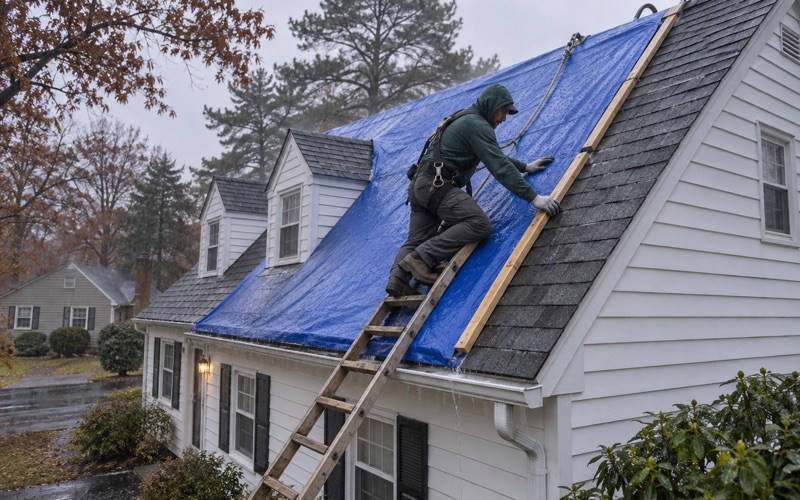
A leak does not wait for a review cycle. If a storm opens up a roof in Ocean Grove, we tarp it and make a temporary repair the same day, photographing everything before anything is moved. Those photos go into a written damage report you can use for your own insurance claim, and if you ask, a member of our crew will meet the adjuster at the house.
A tarp is not the permanent answer, and we say so when we put it on. The lasting repair or replacement then goes through the commission the same way any other exterior roof work would.
Re-Roofing the Rest of Neptune Township
Outside Ocean Grove, the certificate requirement does not apply, and a roof job in Neptune Township looks much like one anywhere else in New Jersey. The township covers about 8.84 square miles and includes Shark River Hills, West Grove, Bradley Park, Whitesville and other neighborhoods. Neptune City is a separate borough with its own government.
Detached homes and owner-occupied streets
Census estimates show that about two-thirds of the township’s housing units are one-unit detached houses, and roughly 70 percent of occupied homes are owner-occupied. For a detached house, a full replacement is ordinary maintenance under the state code, so the work is shaped by the roof’s condition rather than a filing. We still put every scope in writing so you can compare it fairly against another bid.
The township’s housing spans many decades, with large groups of homes built in the 1950s and 1960s alongside newer construction. On older houses the tear-off can expose decking that has reached the end of its life. When that happens we photograph the damaged sheets and show them to you before they are replaced, at the per-sheet price written into the contract.
Attached homes and associations
The township also has attached homes, two-unit buildings and larger multifamily properties. In townhouse and condominium communities, the first question is who actually holds the roof, the owner or the association. We check that against the association’s documents before writing any estimate, so nobody pays for work that belongs to someone else.
For homes going on the market, we can provide a written roof condition report the seller can hand to the buyer’s inspector. Every contract we write follows New Jersey’s home improvement rules, including the three-day cancellation notice.
Weather on the eastern edge of the county
The township falls within the National Weather Service forecast zone for Eastern Monmouth, covered by the Mount Holly office. Coastal wind is a practical concern for edge details, so we pay close attention to drip edge, starter courses and ridge fastening on every replacement. Shingles rated to ASTM D3161 Class F or ASTM D7158 Class H wind resistance are available, and we explain where that rating earns its cost.
At the end of each work day the crew cleans the driveway, yard and gutters and runs a magnet sweep for roofing nails. On a tight Ocean Grove lot or a wider street in West Neptune, the site is left in the same shape it was found.
- 20+ Years on Monmouth County Roofs
- Line-Item Written Estimates
- Same-Day Storm Tarping