Howell Quality Roofing installs metal roofing in Howell, NJ, serving surrounding cities including Ramtown, Freehold Township, Wall, West Freehold and Vista Center, and we have more than 20 years of experience detailing roofs where every edge, wall and penetration has to stay watertight. We install standing seam metal on whole houses, metal accents over porches and bay windows, and repairs to metal roofs already in place.
Metal behaves differently from asphalt. It expands and contracts with every swing in temperature, it sheds water and snow quickly, and it shows every wave in a deck that is not flat. A good metal roof depends less on the panel brand than on the trim, the clips and the flashing around it, and that is where we spend most of our attention.
Our written scope breaks a metal roof into tear-off, decking, underlayment, panels, trim and flashing, ventilation and gutters, each priced on its own line. That makes it easy to compare metal with an architectural shingle roof on the same house, and to see exactly where the extra cost of metal goes.
Standing Seam Metal Roofs
How Standing Seam Works
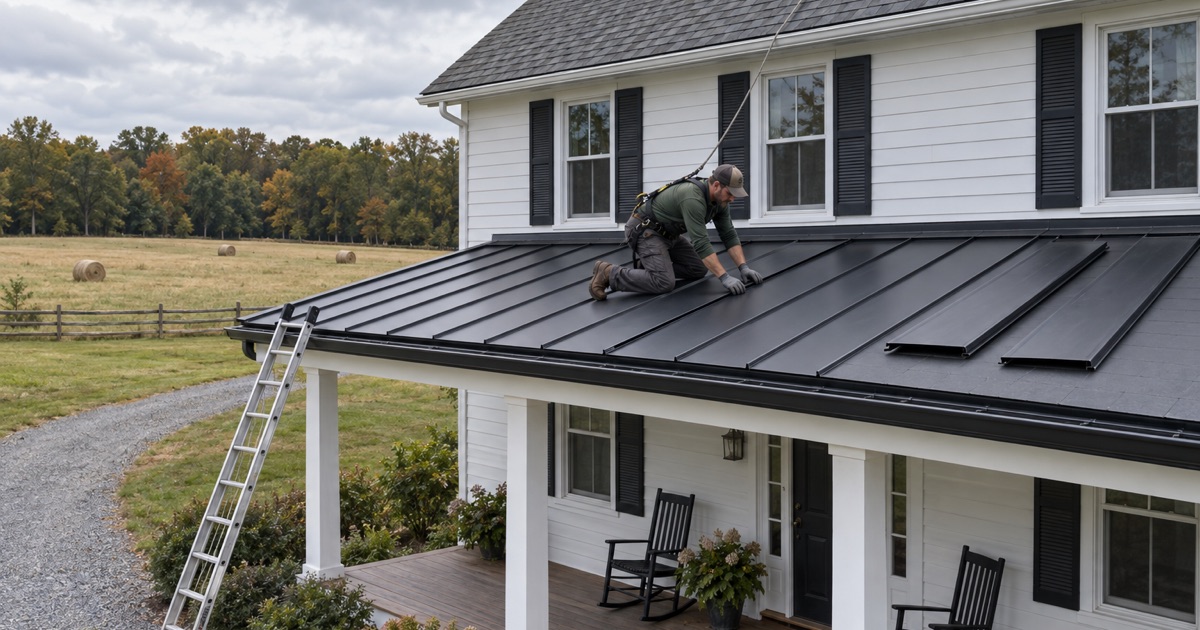
Standing seam panels run in one piece from the eave to the ridge, joined along raised vertical seams that lock or snap together above the flat of the roof. The fasteners are hidden under the seams in clips attached to the deck, so there are no exposed screws to back out or leak as the roof ages.
The clips are what let the roof move. As the panels lengthen in summer sun and shrink on winter nights, they slide in the clips instead of tearing at fixed screws, which is why a properly clipped standing seam roof stays tight long after an exposed-fastener roof has started to loosen.
Panel Profiles, Gauges and Finishes
Panels come in different seam heights, widths and metal thicknesses, and the choice depends on the roof’s pitch, the length of the runs and the look of the house. Factory-applied finishes come in a wide range of colors, from dark bronze and charcoal to traditional barn red, and resist chalking and fading far better than field-painted metal.
Some profiles include striations or stiffening ribs in the flat of the panel to reduce oil canning, the slight waviness that can show on wide, flat metal in low-angle light. We show you sample panels outdoors so you can judge the look before choosing.
Underlayment and Ventilation Under Metal
Under the panels we install a high-temperature synthetic underlayment rated for metal, with ASTM D1970 self-adhering ice and water barrier at the eaves and in valleys. Metal roofs still need balanced attic ventilation, so we check soffit intake against ridge exhaust and use vented ridge closures where the ridge needs to breathe.
Metal Over Porches, Bays and Additions
Accent Roofs on Shingled Houses
Many homeowners keep architectural shingles on the main roof and use standing seam metal over a front porch, a bay window or a shed dormer. The contrast adds character, and metal handles the low slopes found on many porch roofs better than shingles, which need a minimum pitch to shed water reliably.
Where Metal Meets the Main Roof and Walls
The joints between a metal accent roof and the house are where these jobs succeed or fail. We fabricate and install wall flashing, counter flashing set into the siding or masonry, and transition flashing where metal meets shingles, so water from the main roof crosses onto the metal without finding a seam to get behind.
End walls and sidewalls get their own trim pieces, bent to fit the roof rather than forced from stock lengths. A metal porch roof that leaks at the house wall is almost always a trim problem, not a panel problem.
Low-Slope Porches and Additions
Some porches and additions are too flat even for metal. On those roofs we discuss membrane options such as EPDM or TPO, or a modified bitumen system, and explain how each one ties into the house. The right choice depends on the pitch, the drainage and whether anyone walks on the roof.
Trim, Flashing and Details
Eaves, Rakes and Valleys
At the eaves, a drip edge and cleat hold the bottom of each panel and let water drop cleanly into the gutter. Rake trim locks the edge panels against wind uplift, and valleys get a formed metal valley pan under the panels. Each piece is designed to let the panels move while keeping wind-driven rain out.
Chimneys, Vents and Skylights
Penetrations through a metal roof need flashing designed for metal. Around chimneys we install pan and counter flashing with a cricket behind wider chimneys, and around plumbing vents we use flexible boots made for metal panels. Skylights get curb flashing kits matched to the panel profile so the seams flow around them.
Snow Guards and Gutters
Metal sheds snow in sheets. Over doors, walkways, decks and lower roofs, snow guards hold the snow in place until it melts. We also review the gutters, since a sudden slide can tear an undersized or loosely hung gutter off the fascia, and we recommend stronger hangers where a slope will dump snow into it.
Repairing Existing Metal Roofs
Loose Fasteners and Open Seams
On exposed-fastener metal roofs, rubber washers dry out and screws loosen over time, letting water in at every fastener line. We replace failed fasteners with new ones sized for the panel and reseal laps. On standing seam roofs, we reseat seams and replace damaged clips or trim rather than coating over the problem.
Coatings on Older Metal
An older metal roof with surface rust but sound panels can sometimes be cleaned, primed and coated to extend its life. Panels rusted through, badly dented or loose at many seams are usually better replaced. We tell you which situation your roof is in after we have walked it and checked the attic below.
- 20+ Years on Monmouth County Roofs
- Line-Item Written Estimates
- Same-Day Storm Tarping