Howell Quality Roofing has spent more than 20 years on roofing in Freehold Township and across western Monmouth County, and a good share of the calls we take here start with one question: is this mine to fix, or someone else’s? On an older house the answer is simple. On a house that was settled a year or two ago, it depends on dates and definitions most owners have never had a reason to read.
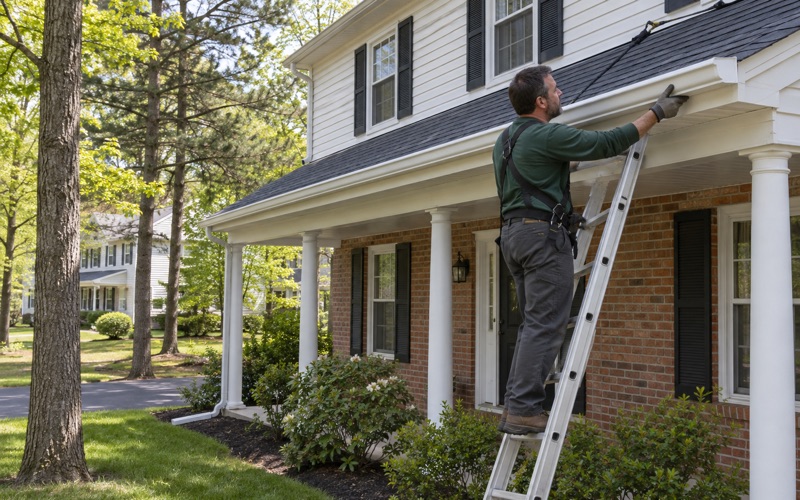
So before we price anything on a newer home, we sort out where it sits. We go up on the roof and into the attic, trace the water to the spot where it actually gets in, and tell you plainly what we found. If the house is still inside its first year, we say so, and we tell you why the builder or warrantor is the first call rather than us.
When the work is ours, you get a straight answer on repair before replacement comes up at all, and a written scope that breaks the job into lines you can hold against any other estimate. The rest of this page covers how the state warranty treats a roof, and what changes once that window closes.
New Construction and the State Warranty in Freehold Township
Freehold Township is a township in western Monmouth County, one of the three original Monmouth townships and governed by a five-member Township Committee. It is not Freehold Borough, the separate town it surrounds, and it is not Upper Freehold. That matters on paperwork, and it matters when a homeowner is trying to work out which offices and which rules apply.
Houses are still going up, a few hundred at a time
The township is not finished building. The Census Bureau’s ACS 2024 five-year estimates count 121 homes built in 2020 or later and 376 built between 2010 and 2019, together 3.7% of the housing here. In 2022 Toll Brothers opened Regent Oaks at Freehold, a 55-plus community of one- and two-story single-family homes with its sales center on Route 9 South.
That is a small slice of the township, but it is the slice where the roof question gets complicated. A house that new carries a state warranty, and the roof’s place in that warranty is narrower than many buyers assume.
What N.J.A.C. 5:25 sets out
New Jersey’s new home warranty rules live in N.J.A.C. 5:25, the New Home Warranty and Builders’ Registration rules run through the Department of Community Affairs. They apply to a new home, which the rules define as a dwelling unit not previously occupied, leaving out units built solely for lease.
The rules stack coverage in layers. For one year from the warranty date, a new home must be free of performance standard defects, appliance and equipment defects, mechanical and electrical defects, and major structural defects. For two years, the mechanical and electrical systems stay covered. For 10 years, only major structural defects remain.
When the clock starts: the warranty date
The warranty date is not the day the roof went on or the day the certificate was issued. Under N.J.A.C. 5:25-1.3 it is the date the owner first occupied the house or the settlement date, whichever comes sooner. If you moved in before closing, the clock may have started earlier than you think.
We ask for that date whenever a newer house calls about a leak. It is the single fact that decides whether the first call goes to the builder or comes to us.
Looking for roofing closer to Wall? See Wall Roofing.
The First Year: Leaks, Lifted Shingles and the Weather Exclusion
The roofing standards in the warranty sit with the performance standards, which means they run for one year from the warranty date. Inside that year, the rules are specific about what counts as a deficiency the builder or warrantor has to correct.
Roof or flashing leaks in normal weather
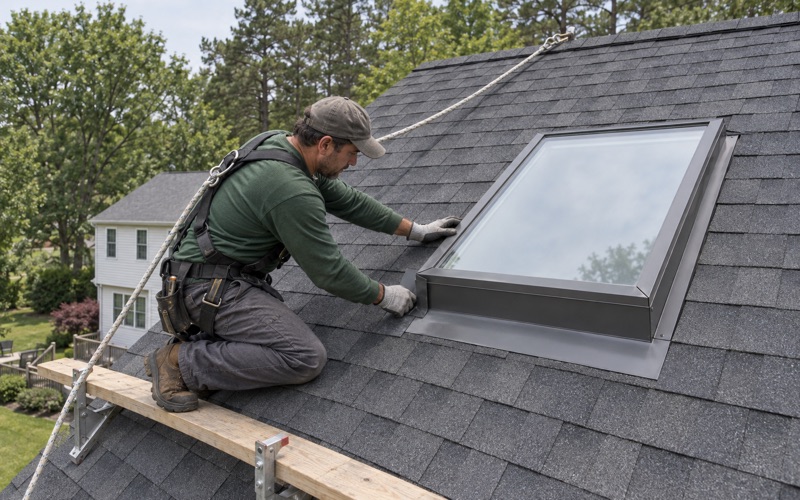
Under N.J.A.C. 5:25-3.5(f)5, roof or flashing leaks that occur under normal weather conditions are a deficiency. The responsibility that goes with it is to correct any leak verified to have happened in normal weather. A drip at a skylight curb, a stain under a valley or water tracking down a chimney chase in an ordinary rain all fall here.
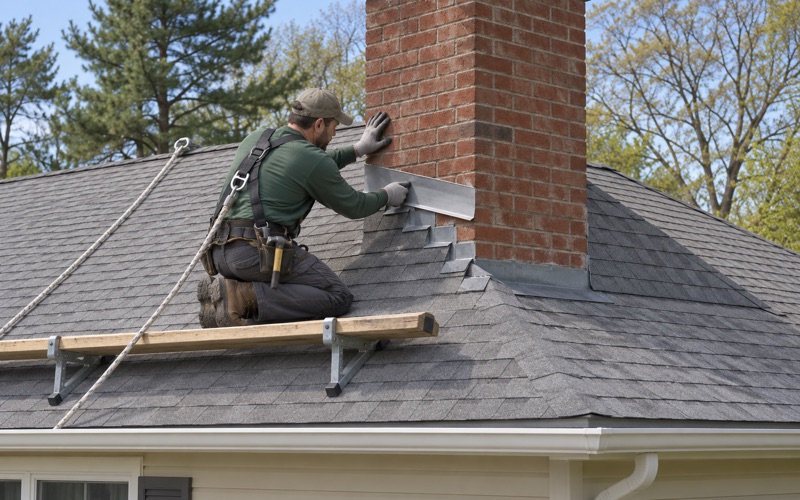
Flashing is where we see it most on new construction: step flashing tucked short along a sidewall, a missing kick-out at the bottom of a roof-to-wall line, a pipe boot that was never seated. Our attic inspection is usually what tells an owner whether the water is roof, flashing or something else entirely, which is useful to have written down before the warranty claim goes in.
Lifted, curled or torn shingles
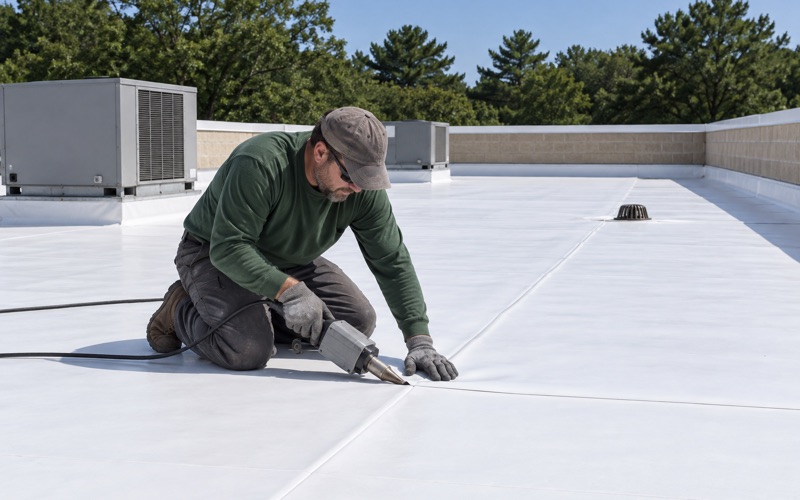
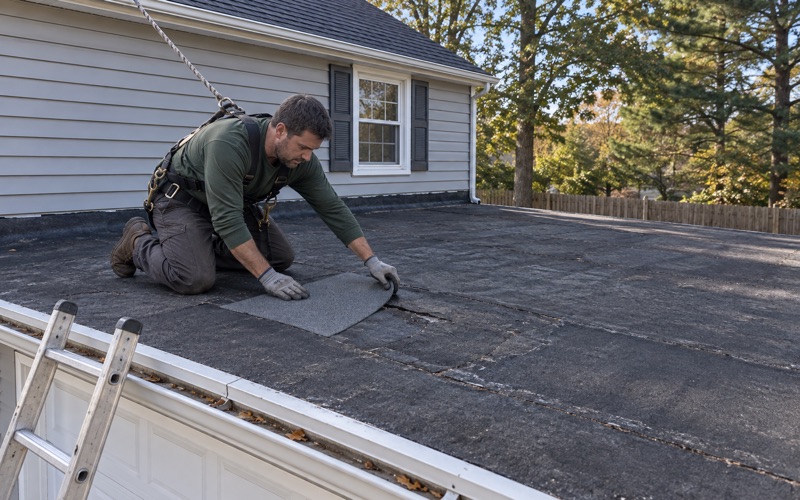
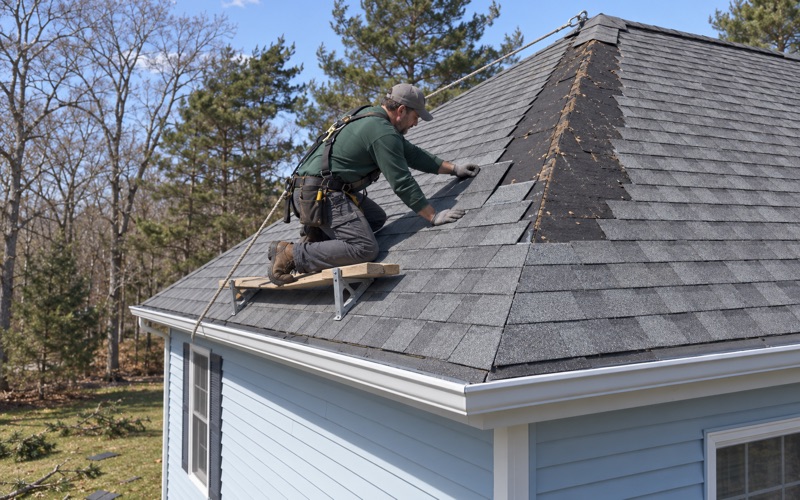
The same section treats shingles that lift or curl during the first year of coverage, or that tear loose in normal weather, as a deficiency. The fix the rules call for is to repair or replace the lifted, curled or torn shingles. On a low-slope section with a built-up roof, the standard is that it drains except for minor ponding, and ponding bad enough to cause a leak has to be repaired.
We can photograph and describe what we see on a first-year roof so you have something concrete to hand the builder. We do not take over the claim, and we do not tell you what any given warrantor will decide.
The weather exclusion
The first-year roofing standard is tied to normal weather, and the rules carve out the rest. Leaks caused by ice and snow build-up, high winds and driven rain are excluded. A shingle torn off in an ordinary breeze is a deficiency; the same shingle torn off in a severe wind event is not, under this section.
That is where owners get caught. If a leak shows up after a nor’easter, the warranty may not reach it, and the question shifts to your homeowner’s policy. In that case we document the damage with photographs and a written report for your own claim, and we will meet the adjuster on site if you ask us to.
After Year One: Structural Defects and Ordinary Repair
Once the first year passes, the roof falls out of the performance standards. What is left in years two through ten is narrower, and it is worth understanding before you assume a leak in year three is someone else’s problem.
What years two to ten actually cover
Years two through ten cover mechanical and electrical systems, for the second year only, and then major structural defects. A major structural defect is defined as actual damage to the load-bearing portion of the home that vitally affects, or is imminently likely to vitally affect, its use as a residence.
An ordinary roof leak is not that. Shingles, underlayment and flashing are not the load-bearing portion of the house, so a leak after the first year is, in practice, a repair, not a structural claim. If a long-running leak has damaged framing, that is a different conversation, and one for the warrantor and an engineer rather than for a roofer’s opinion.
Work you hire during the warranty
The warranty program’s exclusions also leave out work on the new home done by the owner or by a contractor the owner hires. We mention it because it affects timing. If your house is still inside its first year and the roof is leaking in normal weather, calling the builder first keeps that path open.
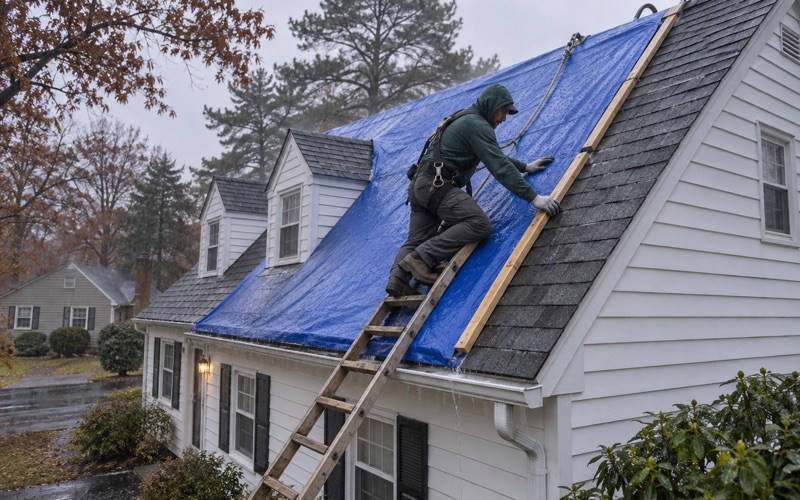
Where a repair cannot wait, such as an active leak into a finished room, we can put on a tarp or a temporary patch the same day, and we take photographs before anything is moved. That gives you a record of the condition the builder would have seen.
Leak repair once the first year is over
After the first year, a leak on a newer Freehold Township house is ordinary roof repair, and it is usually small. On houses this young, we tend to find a fastener issue, a cracked pipe boot, a gap at a sidewall or a ridge vent cap that worked loose rather than a failing roof.
We fix the specific failure and leave the rest alone. A roof a few years old should not be a replacement conversation, and we will not turn it into one.
Roof Repair and Replacement for Older Freehold Township Houses
Most of the township is well past any warranty window. The ACS counts 2,981 homes built in the 1980s and 2,928 in the 1990s, together 44% of the housing, and 6,457 built before 1980. Many of those are on a second or third roof by now, and some on the original.
Housing that is more than detached houses
Freehold Township is mixed housing: 62.2% of homes are detached single-family houses, 16.8% are attached, and 15.2% sit in buildings of five units or more. For townhouses and condominiums, who is responsible for the roof is set by the association’s documents, so we check that before we write an estimate. It saves an owner from paying for work the association already holds.
On detached houses from the 1980s and 1990s, we usually find original decking under one or two layers of shingles, ridge or box vents that were never sized to the attic, and chimney flashing that was reused at the last reroof. Those are the lines we look at hardest.
What our replacement scope covers
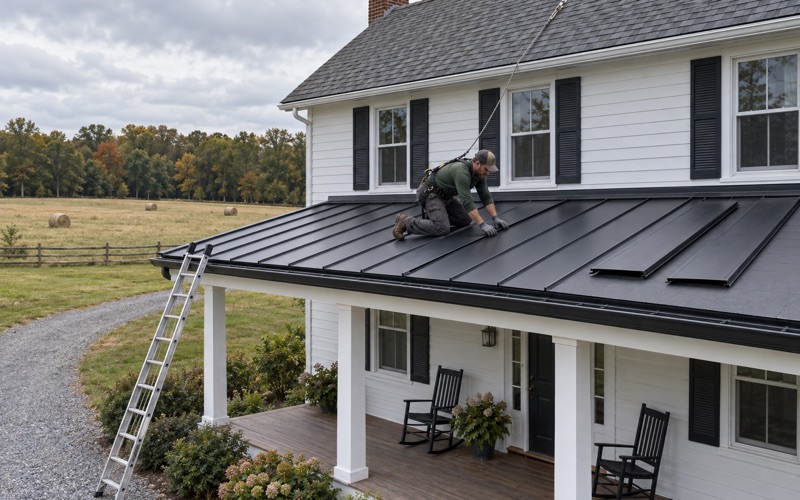
A replacement estimate from us lists tear-off, decking, underlayment, flashing, ventilation and gutters as separate items. If rotten sheathing turns up once the old roof is off, we photograph it and show you before replacing it, at the per-sheet price written into the contract. Step, counter and chimney flashing are replaced with the roof, not reused.
We check attic ventilation on every replacement, because an attic that cannot breathe ages a roof from below. Our contracts follow New Jersey’s home improvement rules, including the three-day cancellation notice. If panels are mounted on the roof, the solar removal and reinstall is planned into the schedule from the start.
Selling a house in the township
Freehold Township is a commercial hub crossed by several major highways, home to Freehold Raceway Mall and CentraState Medical Center, and a buyer’s inspector will look hard at the roof. When you are selling, we can write up a roof condition report you can pass to the buyer’s inspector, describing what the roof is, its condition and anything that needs attention.
At the end of every work day we clean the driveway, yard and gutters and run a magnet over the lawn for nails. Whether the job is a first-year leak you need documented or a full replacement on a 1980s house, you get the same plain answer on what the roof needs and why.
- 20+ Years on Monmouth County Roofs
- Line-Item Written Estimates
- Same-Day Storm Tarping