
Howell Quality Roofing repairs flat roofs in Howell, NJ, serving surrounding cities including Ramtown, Freehold Township, Wall, West Freehold and Vista Center, and our more than 20 years on local roofs include porches, additions, garages, dormers and commercial buildings with low-slope sections. Flat roofs fail differently from shingle roofs, and they need repairs made with the right membrane, the right adhesive and an eye on where the water goes.
Most flat roof leaks start at seams, flashings, drains and penetrations rather than in the middle of the membrane. Water also travels a long way under a flat roof before it shows inside, so we trace it from the room below and the roof above before deciding what to repair.
We tell you plainly whether your flat roof can be repaired or has reached the point where replacement makes more sense. Our estimates list each repair separately so you can see what is urgent and what can wait.
Flat Roof Materials We Repair
EPDM Rubber Roofs
EPDM is a black synthetic rubber membrane used on many porches, additions and commercial roofs. It stays flexible in cold weather but can shrink with age, pulling away from walls and edges. We repair seams with modern seam tape, patch punctures with cured EPDM and primer, and replace flashings that have shrunk away from walls and curbs.
Older EPDM roofs often have seams glued with liquid adhesive that has broken down over the years. Re-taping a seam properly, after cleaning and priming the rubber, restores it to a condition that should last for many more seasons.
TPO and PVC Single-Ply Roofs
TPO and PVC are light-colored thermoplastic membranes with seams welded by hot air. Repairs on these roofs are welded too: we clean the area, weld on a patch of matching membrane and probe the edges to make sure the weld is continuous. Glued or caulked patches on a thermoplastic roof rarely hold for long.
Aged TPO can be harder to weld because its surface has weathered, so we clean it with a membrane cleaner until fresh material shows before welding. Where the old sheet will no longer take a weld at all, that is often the clearest sign the roof is nearing replacement.
Modified Bitumen and Torch-Down Roofs
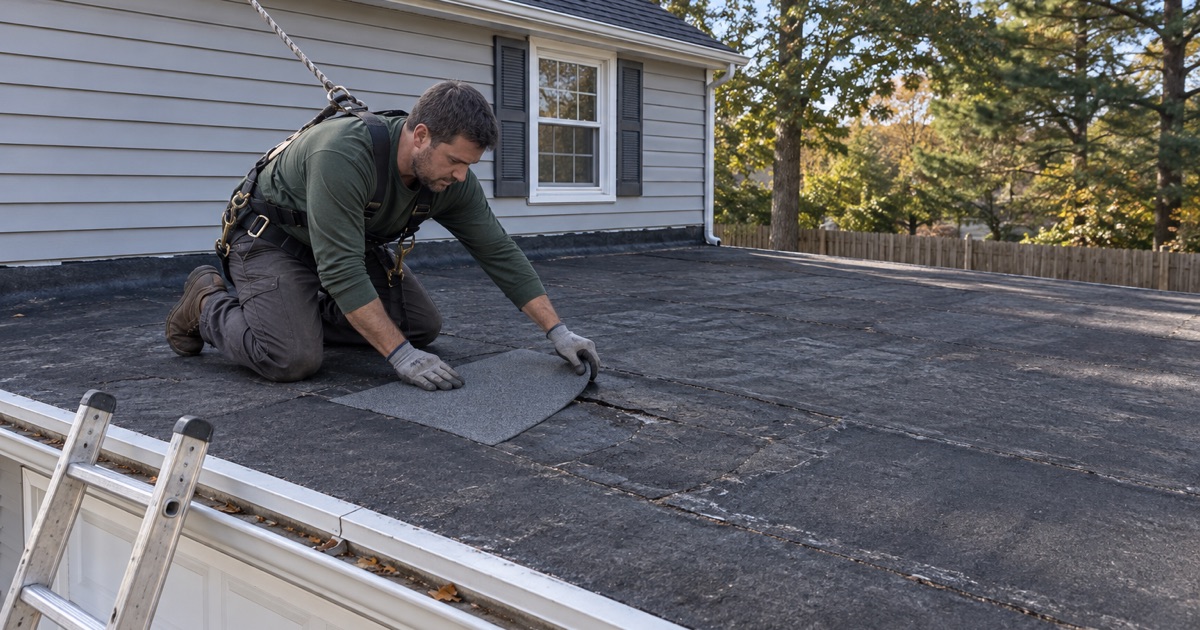
Modified bitumen roofs, including torch-down SBS and APP systems, have a granulated cap sheet over one or more base plies. Over time the cap sheet cracks, seams lift and blisters form. We repair them with compatible modified bitumen, using heat or cold adhesive depending on the location, and we keep open flame away from wood trim, siding and other flammable areas.
Older Built-Up Roofs
Tar and gravel roofs are still found on older commercial buildings. Small blisters and splits can be repaired by cutting out the damaged area and building it back up in layers. When a built-up roof is leaking in many places, we discuss replacement with a modern membrane.
Common Flat Roof Problems
Open Seams and Laps
Seams are the weakest point on any membrane roof. Wind, building movement and years of heat and cold work them loose. We open and inspect each suspect seam, clean and prime it, and reseal it with materials made for that membrane, so water does not find the same gap in the next storm.
Ponding Water
Water that stands on a flat roof for days speeds up wear, adds weight and finds every small defect. We look for clogged drains, sagging deck sections and spots where insulation has compressed. Depending on the cause, we clear the drainage, add tapered insulation crickets to move water toward drains, or repair the structure beneath.
On small residential flat roofs, a scupper or an extra drain at the low point is sometimes the simplest fix. Moving the water off the roof matters more than any coating applied over a ponded area.
Flashings at Walls and Curbs
Where a flat roof meets a wall, a parapet, a chimney or an HVAC curb, the membrane must turn up and be secured under counter flashing or a termination bar. These details loosen over time, especially where caulk was used instead of metal. We rebuild them with proper flashing so water runs over the joint instead of behind it.
Pipe and vent penetrations through a flat roof need the same care. We replace cracked pipe boots and pitch pans with prefabricated flashings made for the membrane, sealed to the field sheet, so each opening is as watertight as the roof around it.
Blisters and Wet Insulation
Blisters form when moisture or air trapped under the membrane expands in the sun. Small, stable blisters may be left alone, but large or broken ones are cut out and repaired. If the insulation underneath is wet, we remove and replace that section, because wet insulation keeps feeding moisture into the deck and loses most of its value.
Flat Roofs on Houses
Porches, Additions and Garages
Many homes have a low-slope section over a porch, a rear addition or an attached garage, often tied into a shingled main roof. The transition between the two is a frequent leak point. We repair the membrane and rebuild the transition with flashing that laps correctly under the shingles above.
Small residential flat roofs are also often the ones homeowners step onto from a window or use as a sun deck. Furniture legs, grills and foot traffic wear through membranes quickly, so where a roof is being used, we recommend walkway pads or a proper deck system that keeps loads off the membrane.
Repair or Replace
A flat roof with a few failed seams and a dry deck is worth repairing. A roof with wet insulation across large areas, widespread cracking or several layers already in place usually needs replacement. We explain what we found, with photos, and price both options when replacement is on the table.
- 20+ Years on Monmouth County Roofs
- Line-Item Written Estimates
- Same-Day Storm Tarping