Howell Quality Roofing handles chimney repair in Howell, NJ, serving surrounding cities including Ramtown, Freehold Township, Wall, West Freehold and Vista Center, and in more than 20 years of roofing we have found the chimney to be the most common source of stubborn leaks. Where a masonry chimney passes through the roof, two very different materials meet, and keeping that joint watertight takes careful flashing work rather than a bucket of tar.
We repair the parts of a chimney that keep water out at the roof: step and counter flashing, the cricket behind the chimney, the crown, the cap and the mortar joints above the roofline. Every repair starts with tracing the water, from the attic and the roof, so we fix the part that is actually leaking.
Our estimates list flashing, cricket, crown, cap and masonry work as separate items. That way you can see which repairs are urgent, which can wait, and how chimney work fits with any roof repair or replacement you are planning.
Chimney Flashing
Step Flashing Along the Sides
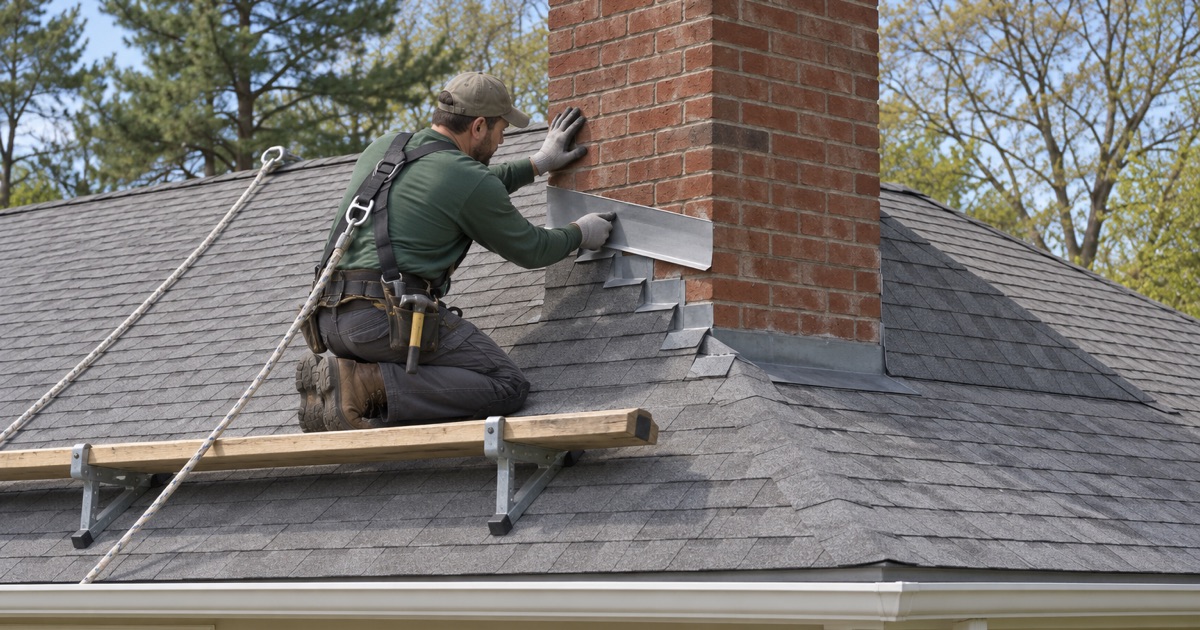
Along the sides of a chimney, each course of shingles gets its own L-shaped piece of step flashing, tucked under the shingle above and turned up against the brick. Water that runs down the roof is passed from piece to piece and onto the shingles below. When step flashing is missing, rusted or replaced by one long strip, water gets behind it and into the attic.
We remove the shingles along the chimney, install new step flashing one course at a time, and reshingle so each piece is lapped correctly. It takes longer than sealing over the old metal, and it is the repair that keeps working.
Counter Flashing Cut Into the Mortar
Step flashing is turned up against the brick, but something has to cover its top edge. That is the job of counter flashing, which is set into a mortar joint or a sawn reglet and folded down over the step flashing. We cut the joint, insert new counter flashing and seal it, so water running down the face of the chimney is carried over the step flashing rather than behind it.
One common problem we see is counter flashing that was simply surface-mounted with caulk along the brick face. That caulk line fails within a few seasons, and the leak returns.
Apron Flashing at the Front
On the downhill face of the chimney, a single apron flashing runs across the front and laps over the shingles below. We replace damaged or short aprons with a piece wide enough to wrap the corners, where many chimney leaks start.
Crickets Behind the Chimney
Why the Uphill Side Leaks
Water running down the roof hits the back of the chimney and has nowhere to go. It pools against the brick, carries leaves and pine needles with it, and in winter freezes into a dam. Even good flashing struggles when water sits against it in every storm.
Building a Cricket
A cricket, or saddle, is a small ridged structure built on the uphill side of the chimney that splits water around both sides. IRC R1003.20 calls for a cricket behind chimneys wider than 30 inches. We frame the cricket, sheathe it, cover it with ice and water barrier and finish it with shingles or metal, flashing it into the chimney like the rest of the roof.
When a cricket is added during a repair, we tie it into the existing roof with new underlayment and flashing so the joint between old and new is as tight as the rest of the chimney.
Crowns, Caps and Masonry
Cracked Chimney Crowns
The crown is the concrete or mortar slab at the top of the chimney around the flue. Over years of freezing and thawing, crowns crack and let water into the masonry below, where it can show up inside looking exactly like a flashing leak. We seal small cracks and rebuild crowns that are broken or were built too thin to shed water.
Chimney Caps
A chimney cap covers the top of the flue to keep out rain, leaves and animals. Without one, water falls straight down the flue and can damage the smoke chamber and the masonry. We install caps sized to the flue, fastened securely so wind does not lift them, and replace rusted or damaged ones.
Repointing Mortar Joints
Mortar between the bricks wears out faster than the bricks themselves. Open, crumbling joints soak up water and let it run down inside the chimney. Repointing means grinding out the failed mortar to a sound depth and packing in fresh mortar, which restores the chimney’s ability to shed water and keeps loose brick from shifting.
We repoint the masonry above the roofline, where weather does the most damage. Chimneys with leaning stacks, many loose bricks or damage below the roof need a mason’s evaluation, and we tell you when that is the case.
Chimney Work With a New Roof
Never Reusing Old Flashing
When we replace a roof, chimney flashing is replaced with it. Old flashing that has been pried up, bent back and nailed again almost never seals the way it did, and reusing it under a new roof is one of the most common reasons a brand-new roof leaks in its first winter.
Coordinating Masonry and Roofing
If the chimney needs repointing or a new crown, the best time is before or during the roof replacement, while the area around it is open and staging is in place. We schedule the masonry and flashing work together so the chimney and the new roof are finished as one watertight system.
- 20+ Years on Monmouth County Roofs
- Line-Item Written Estimates
- Same-Day Storm Tarping