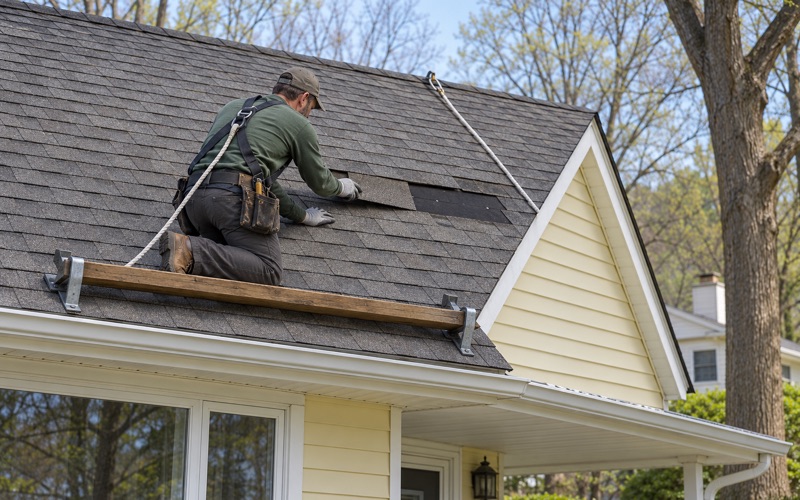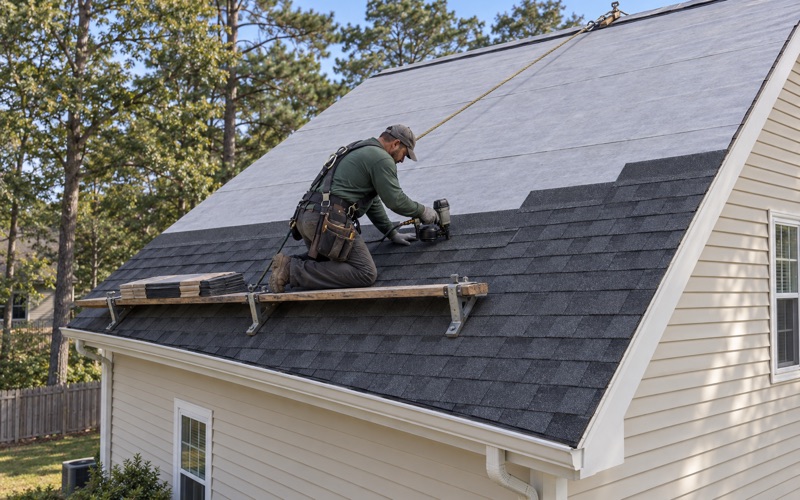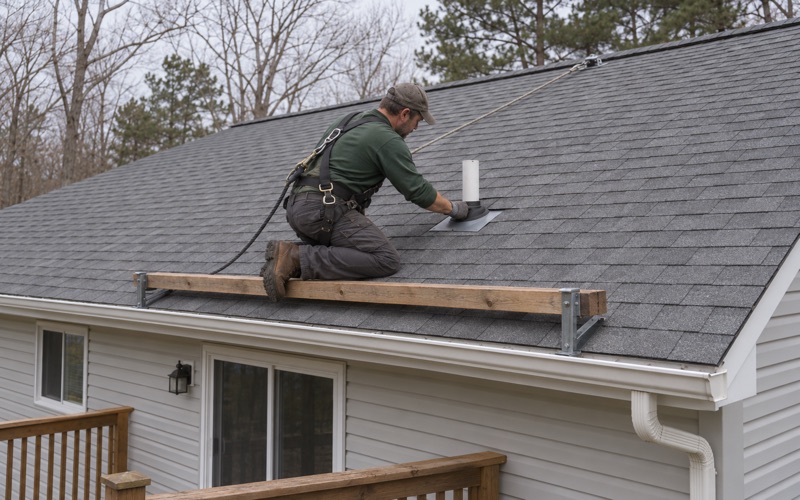
Howell Quality Roofing has spent more than 20 years on roofing in Brielle and the rest of Monmouth County, and on a house near salt water the first decisions we make are about the parts nobody sees. The nails, the staples and the warranty category a roof falls under are settled on paper before a bundle or a panel is ordered, because those are the choices that are hardest to undo once the roof is on.
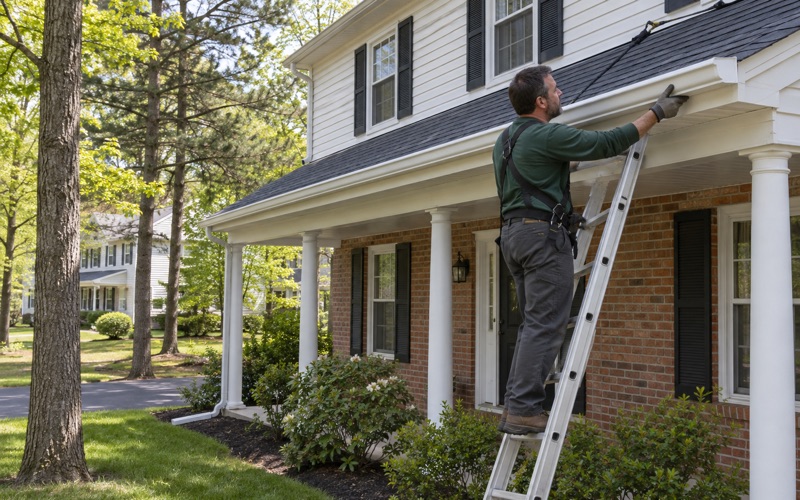
Most roofing questions start with a leak or a worn slope, and ours do too. On a leak call we go into the attic as well as onto the roof, so the water is traced to where it actually enters, and you get a plain answer on whether the roof can be repaired before replacement is ever raised.
When replacement is the right call, the estimate lists tear-off, decking, underlayment, flashing, ventilation and gutters as separate lines. That makes it possible to put our number beside anyone else’s and see exactly where the two differ, including the fastener specification this page is mostly about.
Four Miles of Tidal Water and Two Ways to Measure It
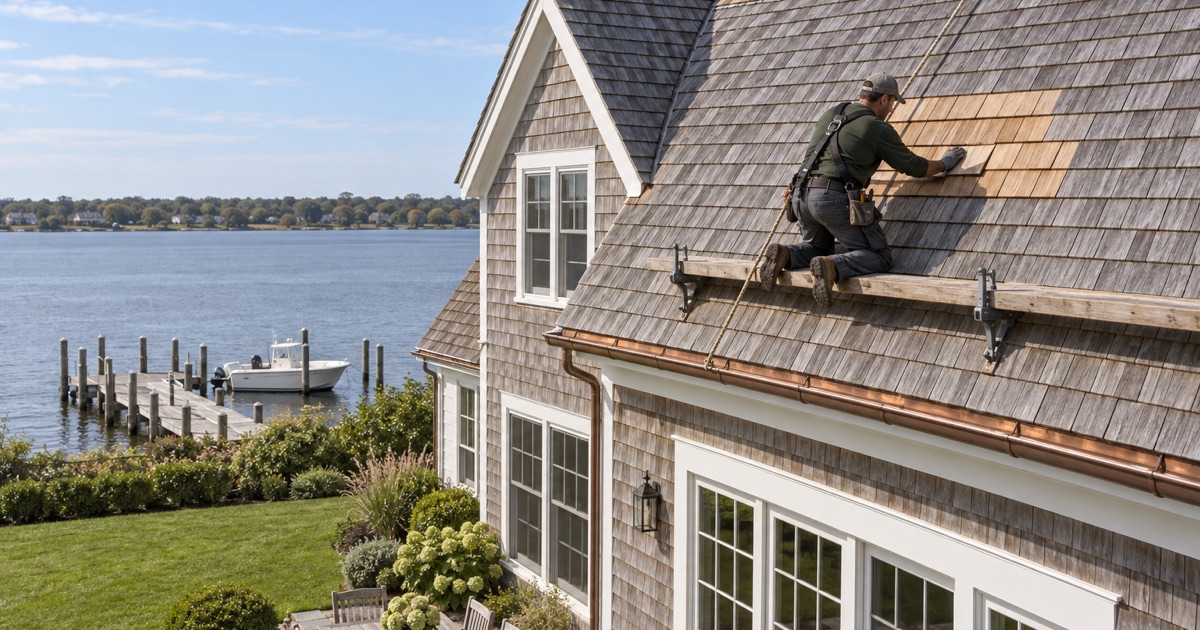
Brielle is a borough in southern Monmouth County with about 4.0 miles of salt-water, tidal waterfront on the Manasquan River, Glimmerglass and Debbie’s Creek. The borough covers 2.37 square miles, and 0.61 of them are water, so a good share of its homes sit on or near a tidal edge.
That matters to a roof because salt air corrodes metal, and roofing products are built from more metal than most owners realize. Nails, staples, flashing, drip edge and metal panels all react to salt exposure, and the manufacturers and trade groups behind those products have written rules about it.
Miles versus feet
The surprising part is that those rules do not agree on how to measure salt exposure. The cedar industry draws its line in miles from salt water, with no distinction between an ocean and a river, while metal panel warranties draw theirs in feet and sort the water into kinds.
On a Brielle job the two scales can give very different answers for the same house. A cedar roof and a metal roof on the same street may face completely different questions, and neither question is answered by the other.
Why a river is the hard case
A house on the ocean is easy to classify under either system. A house on a tidal river is not, because the river is salt and tidal yet is neither open surf nor an obvious bay.
That is the situation along much of Brielle’s waterfront, and it is the reason we treat the fastener and warranty questions as part of the estimate rather than something sorted out at the supply house.
Looking for roofing closer to Neptune City? See Roofing Services in Neptune City.
Cedar Shakes and the Fifteen-Mile Salt-Water Rule
The Cedar Shake and Shingle Bureau publishes roof fastener guidelines for cedar shakes and shingles. They require stainless steel Type 316 nails in locations within fifteen miles of salt water, and if staples are used, those must be Type 316 within that same zone.
Outside the salt-water zone the bureau allows Type 304 or Type 316 stainless, or hot-dipped galvanized nails with an ASTM A 153 Class D coating. A borough with its own tidal frontage sits well inside fifteen miles of salt water, so on the bureau’s measure a cedar shake roof in Brielle calls for Type 316.
Type 316 versus Type 304
Both are stainless steel, and both look the same in a box. Type 316 is the grade the bureau names for salt-water locations, while Type 304 is allowed only outside that zone, so a cedar roof here should be fastened with 316 throughout.
The guidelines also warn buyers not to be fooled by fasteners labeled with a “Number” 304 or 316. The proper specification includes the word “Type,” and we check the packaging against that wording before the fasteners go up on the roof.
No electrogalvanized fasteners
The bureau is blunt on one point: do not use electrogalvanized fasteners. That instruction applies inside and outside the salt-water zone alike, so there is no Brielle cedar roof where an electrogalvanized nail is acceptable.
Fire-retardant and preservative-treated shakes carry their own requirement under the same guidelines. They call for Type 316 regardless of location, so a treated cedar roof in Brielle lands on Type 316 by two separate routes.
A manufacturer guideline, not a code
The bureau states that its guidance is not intended to supersede local building codes. We treat it as the product’s own installation standard, which is what a cedar warranty and a long-lived roof depend on.
In practice that means the fastener grade is written into our scope as its own line. An owner comparing cedar estimates can see whether each one names Type 316 or leaves the grade unstated.
Repairs on an existing cedar roof
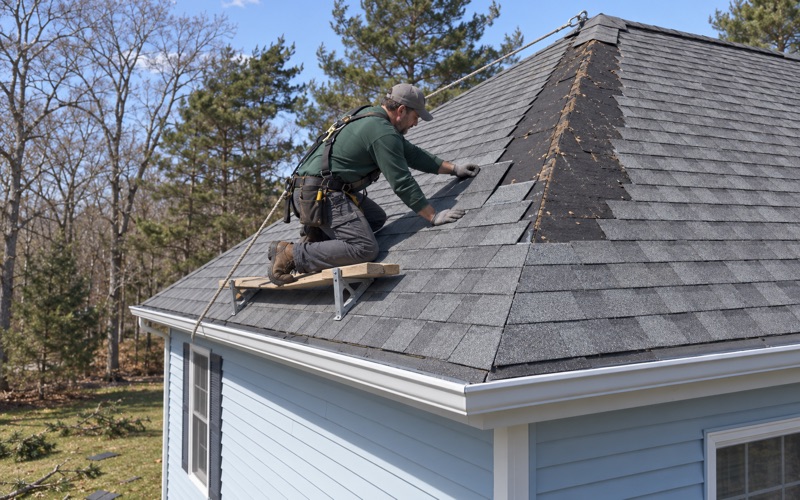
The same grade question comes up on a repair. When we replace damaged shakes on an older cedar roof, the new fasteners are Type 316, whatever the original installer happened to use.
If we find corroded or stained fasteners while we work, we photograph them and show you. Rusting nails on a cedar roof near the water are worth knowing about, because they can point to a wider problem than the few shakes that prompted the call.
Surf, Large Bay or Marsh: Where a River Fits on Metal
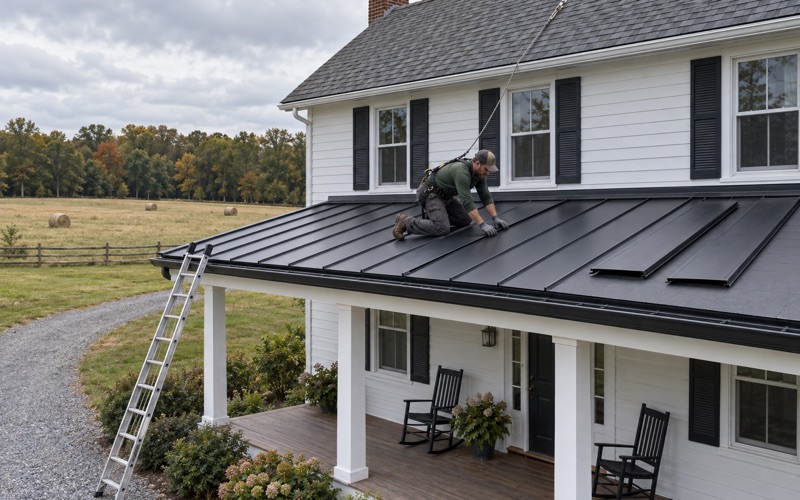
Standing seam and other metal panels are a popular choice near the water, but the paint and coating warranties behind them carry distance exclusions. The numbers vary by manufacturer and by the kind of shoreline involved.
Drexel Metals’ 25-Year DREXLUME warranty, revised in January 2025, excludes installations closer than 2,800 feet to a coastline with surf, 1,200 feet to a large bay and 600 feet to marshes and canals. Installations closer than those lines are excluded and not covered.
A second manufacturer, different lines
Sheffield Metals’ 45-Year AZ55 Galvalume sample warranty uses the same three kinds of water with shorter distances. It excludes a coastline with breaking surf within 1,500 feet, a coastline with a large bay within 800 feet and a coastline with marsh within 400 feet.
The gap between the two shows why we never assume one manufacturer’s terms carry over to another. A house that clears one warranty’s line may sit inside the other’s, and the panel choice can change the answer.
The missing category
Neither document has a category for a tidal river, and neither defines what counts as a large bay. The Manasquan River, Glimmerglass and Debbie’s Creek are all salt and tidal, but the warranties do not say which of their lines, if any, applies to them.
We do not guess at that. Which line governs a waterfront house in Brielle is a question for the panel manufacturer, asked with the address in hand, and we want their answer in writing before a single panel is ordered.
What we bring to that conversation
A manufacturer can only answer a location question if it is asked precisely. We give them the street address, the name of the water the house faces, the approximate distance from the roof to the water’s edge and the exact panel and coating being considered.
If the answer comes back that a location is excluded, or the manufacturer will not commit either way, we tell you before anything is signed. At that point the choice between a different metal product, a different material or accepting the stated terms is yours to make with the facts in front of you.
Asphalt shingles near the water
Owners often ask whether the same kind of exclusion applies to asphalt shingles. We have not found a coastal exclusion of that kind in GAF or Owens Corning terms, so the distance question on this page is specific to metal panels.
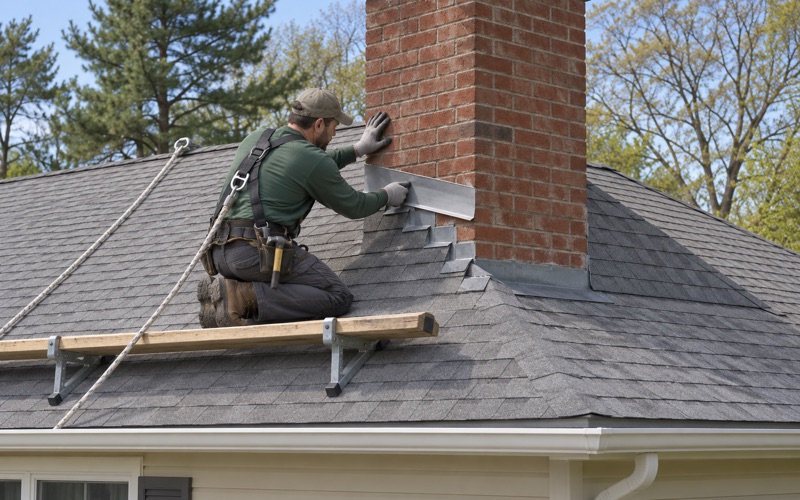
Shingle roofs still have metal in them, from drip edge to step and counter flashing. On those parts we choose corrosion-resistant material suited to a salt-air location, and we replace the flashing with the roof rather than reusing old metal under new shingles.
Settling the Specification Before Anything Is Ordered
On a Brielle waterfront house the order of operations matters. The fastener grade and the warranty category are settled first, the material is chosen to match, and only then does anything get ordered or scheduled.
Getting that sequence wrong is expensive to fix. A roof fastened with the wrong grade, or a metal roof installed inside an exclusion line, may look fine on the day it is finished and still fall short of what the manufacturer stands behind.
What we put in writing
For cedar, the scope names Type 316 nails or staples and rules out electrogalvanized fasteners. For metal, it names the panel manufacturer and records what that manufacturer said about the property’s location before the order goes in.
Those lines sit alongside tear-off, decking, underlayment, ventilation and gutters, each priced separately. If the old roof comes off and decking is damaged, we photograph it and show you before replacing it, at the per-sheet price already set in the contract.
The rest of the replacement
Attic ventilation is checked on every replacement, because a roof that cannot breathe ages from underneath no matter how good its fasteners are. Ridge vent and soffit intake are sized together so the new roof is not undone from the inside.
On a detached one- or two-family house, replacing the roof covering is ordinary maintenance under N.J.A.C. 5:23-2.7. Attached homes and buildings with three or more units fall outside that rule, and we sort out which applies before work is scheduled. Census estimates count 1,721 of Brielle’s 1,901 occupied homes as owner-occupied, and 1,446 of those are detached houses.
After a wind storm
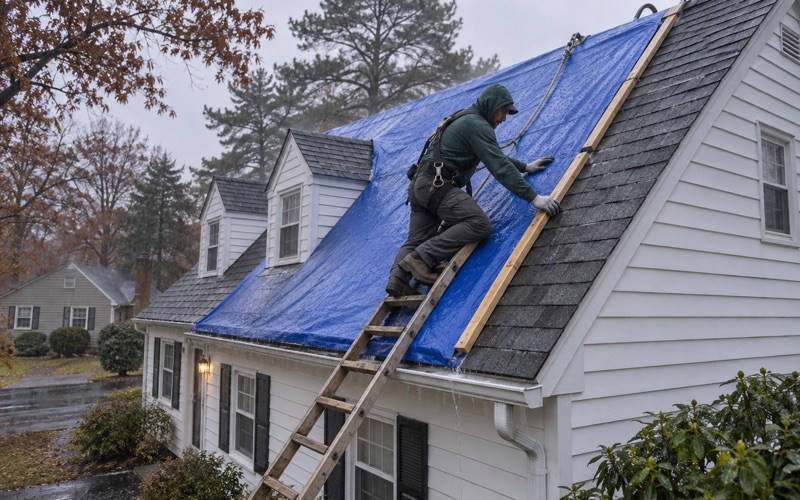
When a storm lifts shingles or opens a seam, tarps and temporary repairs go on the same day, and we photograph the damage before anything is moved. The photos and a written description are yours to use for your own insurance claim.
If you ask, our crew will meet the insurance adjuster at the house to point out what we found. The claim itself stays between you and your insurer.
Contracts and cleanup
Our contracts follow New Jersey’s home improvement rules, including the three-business-day cancellation notice. You have the full written scope, with the fastener and warranty lines spelled out, before you are committed to anything.
At the end of each work day the driveway, yard and gutters are cleaned, and a magnet sweep picks up stray roofing nails. On a waterfront lot, that includes the edges of the yard where debris can drift toward the water.
- 20+ Years on Monmouth County Roofs
- Line-Item Written Estimates
- Same-Day Storm Tarping