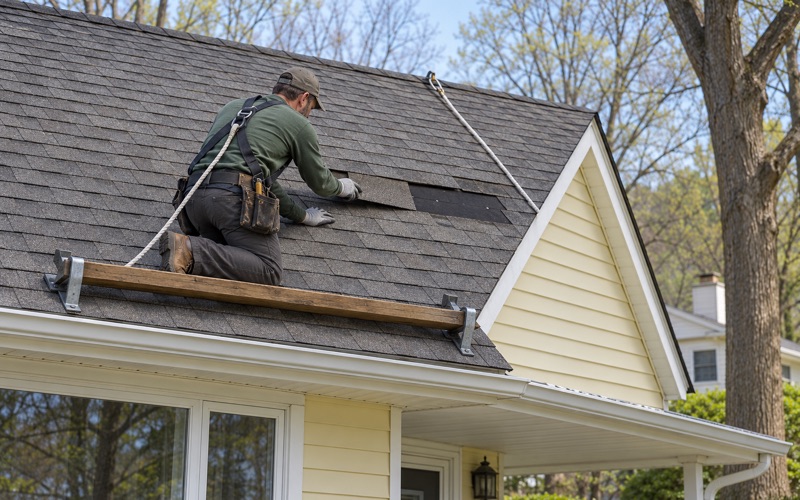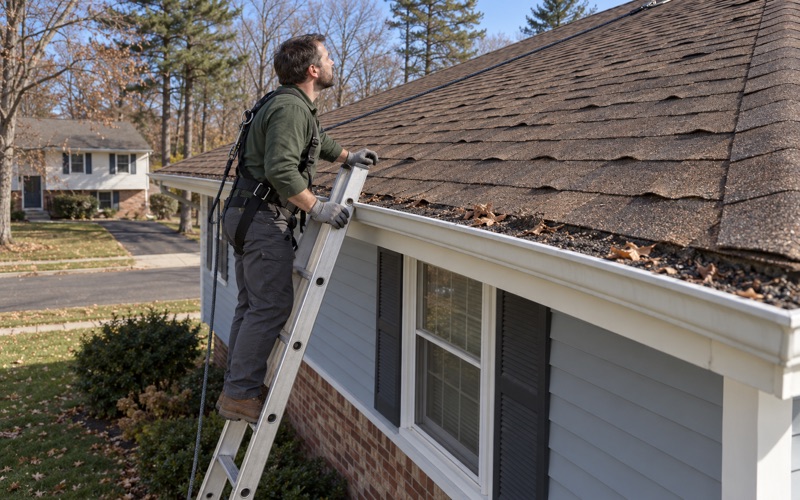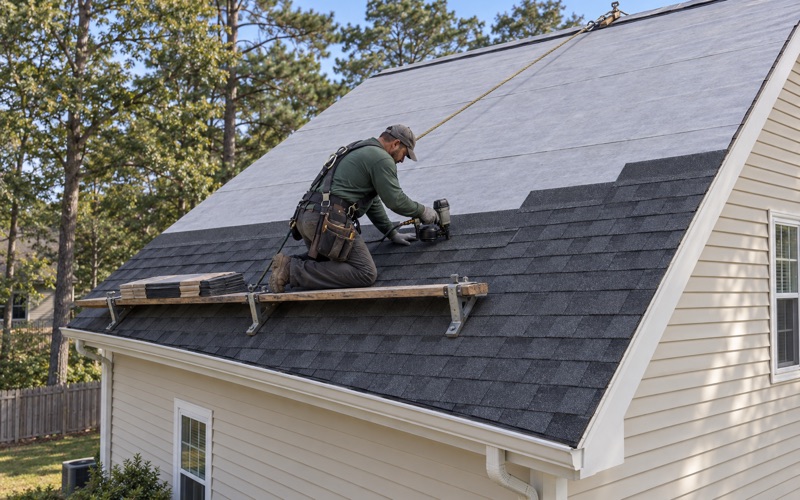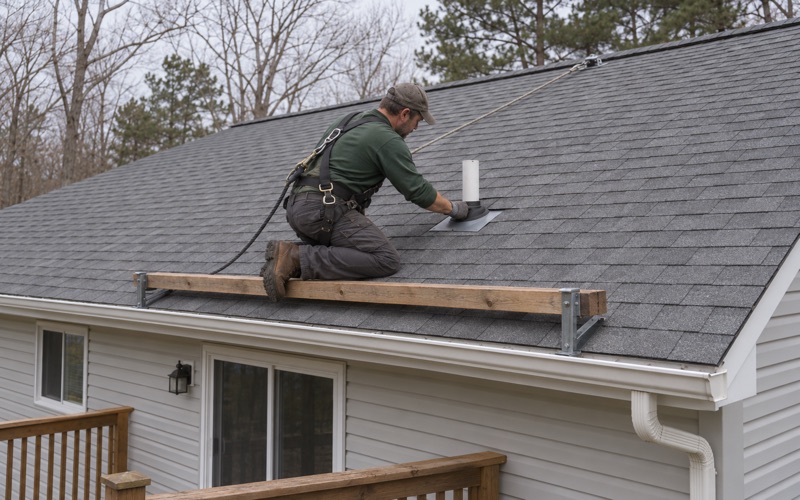
Howell Quality Roofing has spent more than 20 years on roofing in Belmar and across the Monmouth County shore, and the first thing we settle on any borough job is whether the roof can be repaired at all. You get that straight answer before replacement comes up. On a leak call we look in the attic as well as on the roof, so the water is traced to the spot where it actually gets in before anything is priced.
When replacement is the right call, the estimate is written line by line. Tear-off, decking, underlayment, flashing, ventilation and gutters each get their own entry, so an owner holding two bids can compare them item by item instead of guessing what a single lump sum covers.
There is one more question we raise early on a re-roof here, and it has nothing to do with shingle color. Belmar runs its own flood damage prevention rules, and those rules can reach a roof job even where the state construction code treats the same work as ordinary maintenance. The sections below explain how that works and what it means for planning.
Belmar’s 2022 Flood Maps and Class 5 Rating
Belmar’s current effective flood insurance rate maps took effect on June 15, 2022. FEMA’s Community Status Book lists the borough as community 345283C, a participant in the National Flood Insurance Program since May 1972, when its first flood maps were also issued.
A Class 5 community since 2020
Belmar entered FEMA’s Community Rating System on May 1, 2015, and has held Class 5 since May 1, 2020. Under that rating, flood insurance policies written through the National Flood Insurance Program for properties in the borough carry a 25% discount on premiums.
That discount belongs to the flood insurance policy, not to a roof. A roofing contract does not earn it or change it, and we keep it out of any conversation about what a new roof will cost.
Why the rating touches a roof job
A community keeps a rating like this by actually running its floodplain program, and that includes reviewing work on buildings in mapped flood areas. In Belmar, that review is written into the borough code, which is where a re-roof enters the picture.
For an owner, the practical upshot is that the flood office may want to see a job before it starts. Knowing that at the estimate stage costs nothing, while learning it in the middle of a tear-off can stall a crew and leave a roof open to the weather.
Looking for roofing closer to Point Pleasant Beach? See Roofing in Point Pleasant Beach.
Chapter 35 and the Floodplain Development Permit
On April 5, 2022, about ten weeks before the new maps took effect, Ordinance No. 2022-09 rewrote Chapter 35, Flood Damage Prevention, in its entirety. The chapter is titled the Floodplain Management Regulations of the Borough of Belmar, and it is applied alongside the flood provisions of the Uniform Construction Code and the state Flood Hazard Area Control Act rules at N.J.A.C. 7:13.
Roofing is named in the code
The rewritten chapter speaks directly to ordinary maintenance and minor work, and roofing is called out by name. Per the code text, that work, including non-structural replacement-in-kind of roofing, is evaluated by the floodplain administrator through the floodplain development permit to ensure compliance with the substantial damage and substantial improvement section, 35-3.14.
We have read that language as a search excerpt rather than the full chapter, so we treat it as a reason to ask, not a script for what the office will decide. The borough’s own text and its floodplain administrator are the authority on how it applies to a given building.
A flood review, not a building permit
In New Jersey, repairing or replacing the roof covering on a detached one- or two-family house is ordinary maintenance under N.J.A.C. 5:23-2.7, with no construction permit required. The floodplain development permit is a separate local review that sits beside the construction code, and it is not a construction permit by another name.
That distinction matters because the two can point in different directions on the same house. A re-roof the construction office would never see can still be a matter for the flood office when the building sits in a mapped flood area.
Buildings outside the exemption
The state exemption covers detached one- and two-family dwellings only. A building of three or more units falls outside it, so a re-roof there follows the construction code’s own path in addition to anything the flood review asks for.
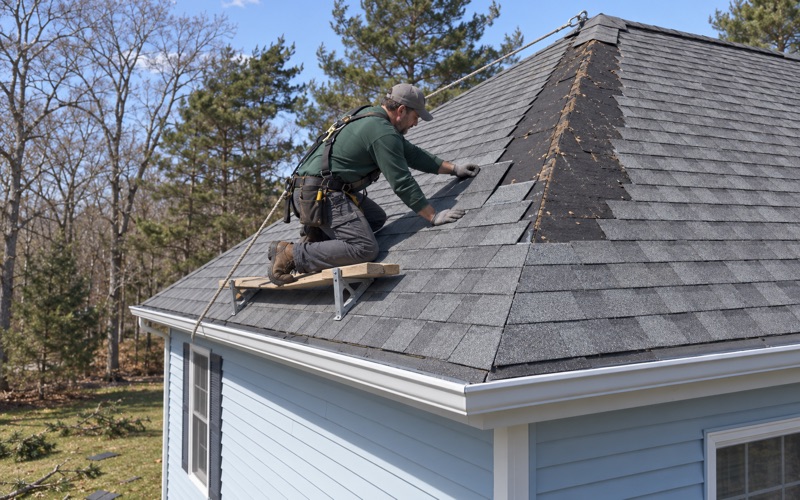
We confirm the building type before pricing, because it changes both the paperwork and the schedule. The same is true of the roof layers, since the state rehabilitation subcode calls for a tear-off when a roof already carries two or more layers.
Substantial Improvement and Where the Building Sits
Substantial improvement is the floodplain test for whether work on an existing building is large enough to bring flood-resistant construction requirements into play. Chapter 35 points roofing work at section 35-3.14, which is where Belmar sets out its substantial damage and substantial improvement rules.
What we have not read
We have not read the text of 35-3.14 itself, so we will not quote a percentage, a counting method or any look-back period for the borough. Anyone who states those figures for Belmar should be able to show you the section they came from.
What we can say is that a roof job rarely happens in isolation from other work on the same building. If a re-roof is one part of a larger renovation, the floodplain administrator is the one who weighs it, and we write our scope so the paperwork describes the roof work accurately.
Zone X in the center, AE and VE at the water
FEMA’s National Flood Hazard Layer puts the borough’s center point on map panel 34025C0342G, effective June 15, 2022, in Zone X, an area of minimal flood hazard. Two other points sampled inside town also returned Zone X.
The edges read differently. A point on the Shark River returns Zone AE with a base flood elevation of 9 feet, and a point at the ocean edge returns Zone VE with a base flood elevation of 10 feet.
Those are point readings, and the two water points were taken at the water rather than at a house. No Belmar street has been assigned a zone here, so the zone for a specific building comes from FEMA’s map at that address, not from a general description of the town.
Older housing in a waterfront borough
Belmar covers about 1.6 square miles on the south side of the Shark River, and more than a third of that area is water. Of the 3,899 housing units counted in the 2024 five-year American Community Survey, 1,227 were built in 1939 or earlier.
An older house can bring layered roofs, tired decking and flashing details that have been patched more than once. Those conditions shape the scope, and on a building in a mapped flood area they also shape the description the floodplain administrator will read.
Planning a Re-Roof on a Belmar Flood-Zone Building
Our planning on a Belmar job starts with the address. We look up the flood zone on FEMA’s map, confirm the building type and ask whether any other work is planned on the building in the same stretch of time.
Talk to the floodplain administrator first
If the building maps into Zone AE or Zone VE, we suggest the owner contact the borough’s floodplain administrator before a start date is set. Whether a particular re-roof needs a floodplain development permit, and what the office wants to see, is that office’s call.
We provide the written scope for that conversation. A clear description of a like-for-like replacement, with the materials listed, gives the office what it needs to judge the work against the substantial improvement section.
Decking, flashing and ventilation
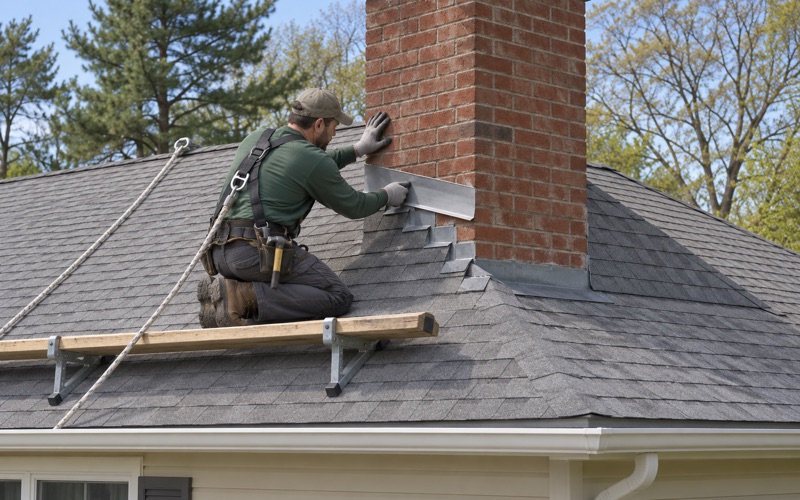
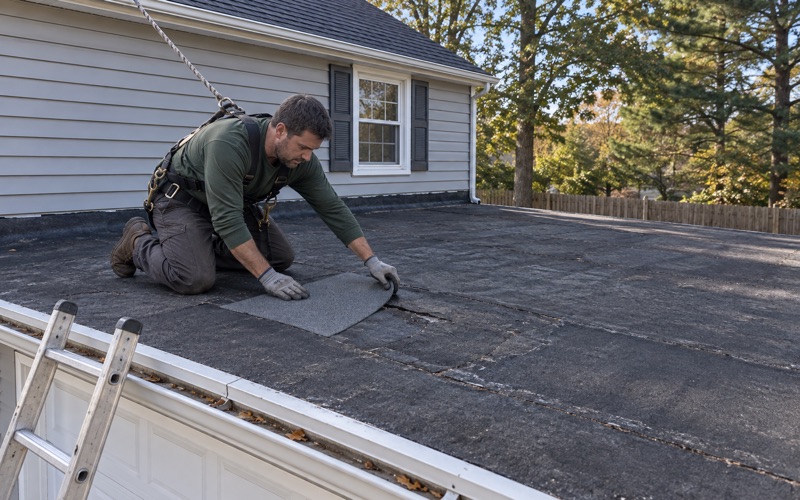
Once the old roof is off, any damaged decking is photographed and shown to you before it is replaced, at the per-sheet price already set in the contract. Step, counter and chimney flashing is replaced with the roof instead of being reused under new material.
Attic ventilation is checked on every replacement, because a roof that cannot breathe ages from underneath. This close to the ocean, we also pay attention to drip edge at the eaves and rakes and to shingles rated for wind, such as ASTM D3161 Class F or ASTM D7158 Class H.
Contracts, storms and cleanup
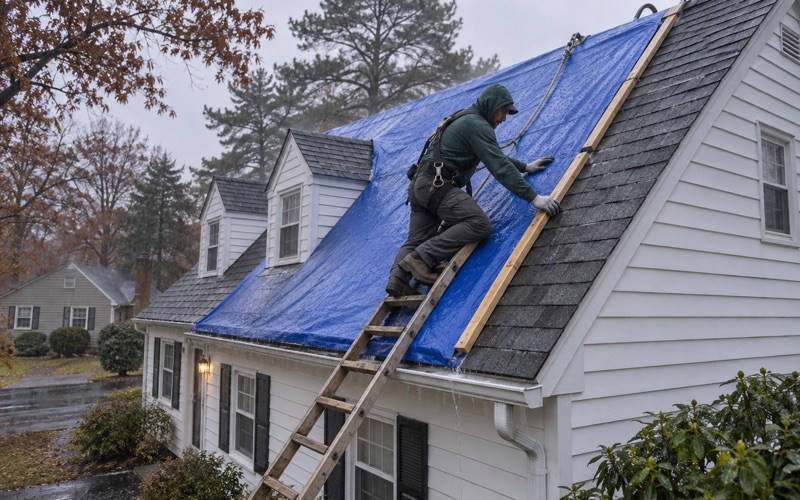
Our contracts follow New Jersey’s home improvement rules, including the three-day cancellation notice. After a wind storm, tarps and temporary repairs go on the same day, with photos taken before anything is moved.
If you file a claim on your own policy, we photograph the storm damage, write it up and will meet the adjuster on site when asked. Negotiating a claim for pay is a job for a licensed public adjuster, so our role stays with documenting the roof.
At the end of each work day, the driveway, yard and gutters are cleaned, including a magnet sweep for roofing nails. A stray nail in a driveway is a flat tire waiting to happen, so the sweep is part of the job rather than an extra.
- 20+ Years on Monmouth County Roofs
- Line-Item Written Estimates
- Same-Day Storm Tarping