Howell Quality Roofing brings more than 20 years in the trade to roofing in Asbury Park, and the first thing we settle on a job here is not the shingle color. It is what kind of building the roof sits on, because New Jersey treats a re-roof on a detached house very differently from one on a three-family building.
That single question decides whether the work is ordinary maintenance with no paperwork at all, or construction-permit work that goes through the city before a crew strips a single shingle. In this city the answer can change from one lot to the next on the same block.
Below we walk through where that line falls, what it means for owners of two-family and three-family buildings, and how we plan a job on each side of it. Whichever side your roof is on, we start the same way: a look in the attic as well as on the roof, and a straight answer on repair before replacement ever comes up.
Where New Jersey’s No-Permit Re-Roof Rule Stops
The rule comes from the state Uniform Construction Code. N.J.A.C. 5:23-2.7(c) lists the items that count as ordinary maintenance and says no permit, inspection or notice to the enforcing agency is required for them. Item (c)1.x is the one that matters to a roofer: “The repair or replacement of existing roof covering on detached one- and two-family dwellings.”
Every phrase in that sentence narrows it. It covers roof covering, not structure, and subsection (b) keeps work affecting structural or fire safety out of ordinary maintenance. It covers dwellings with one or two units, and it covers detached ones only; the siding item right below it leaves out the word detached, but the roofing item keeps it.
Why the Line Lands Mid-Block Here
In many suburban towns almost every house sits comfortably inside that exemption. Asbury Park is different. The American Community Survey 2024 five-year estimates count 1,943 detached houses in the city, about 22.4 percent of its housing units, alongside 850 units in two-unit buildings, 909 units in three- and four-unit buildings, 615 attached single-family homes and 4,289 units in buildings of five or more.
Put plainly, close to half of the city’s housing units sit in buildings of five or more, and a sizable share of the rest sits in attached rows or small multifamily buildings. For an Asbury Park owner, the dividing line often falls between the two-family house and the three-family next door.
What We Do Not Assume
The census tables do not say how many of those two-unit buildings are detached, so we never treat a duplex as exempt just because it holds two units. We look at the building itself: whether it shares a wall, whether its roof runs continuously over a neighbor’s, and how the lot is laid out.
We also do not quote what the city charges for a multifamily roofing permit or how long review runs. Those are questions for the Construction Department, and we would rather you hear the current answer from the office that sets it.
Looking for roofing closer to Belmar? See Belmar Roofing.
Detached One- and Two-Family Houses
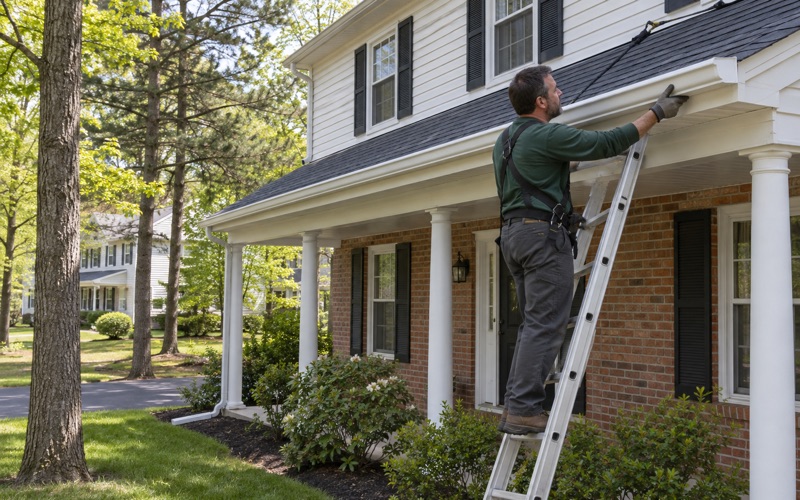
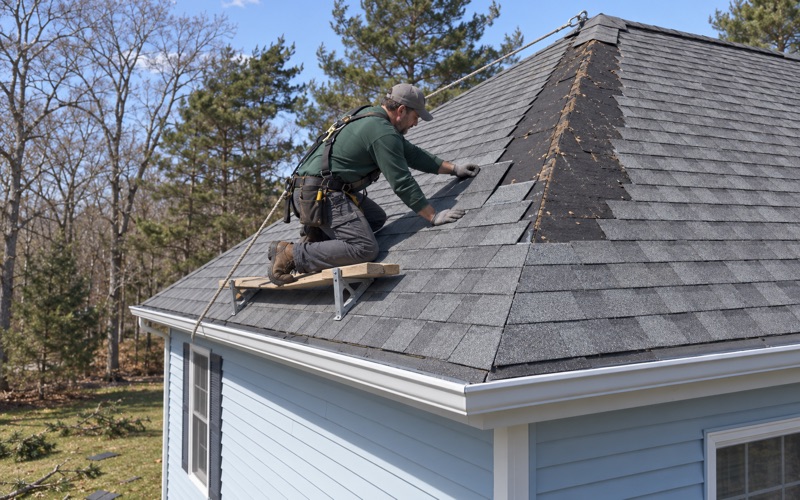
If your home is a detached single-family house or a detached two-family, replacing the roof covering is ordinary maintenance under the state rule. No construction permit, no inspection and no notice to the city is required for the covering itself. That does not make the job casual; it means we are responsible for doing it right without a municipal inspector checking behind us.
Where a Detached Re-Roof Can Still Cross the Line
The exemption covers the covering. When tear-off reveals rotted rafters, a sagging ridge or framing that has to be rebuilt, the work starts to affect structure, and that part falls outside ordinary maintenance. New Jersey’s rehabilitation subcode adds its own re-roofing rules as well, calling for a full tear-off rather than another layer where two or more layers already exist or where the roof is slate, wood shake or tile.
When we run into one of those conditions, we stop and tell you before anything else happens. Damaged decking is photographed and shown to you before it is replaced, at the per-sheet price already written into the contract.
Older Detached Houses
Asbury Park’s housing is old. The same census estimates date 3,225 of the city’s 8,681 housing units to 1939 or earlier, and some of the oldest neighborhoods were built up in the 1890s in a full range of Victorian architecture. Roofs from that era tend to carry more valleys, dormers and wall intersections than a simple gable.
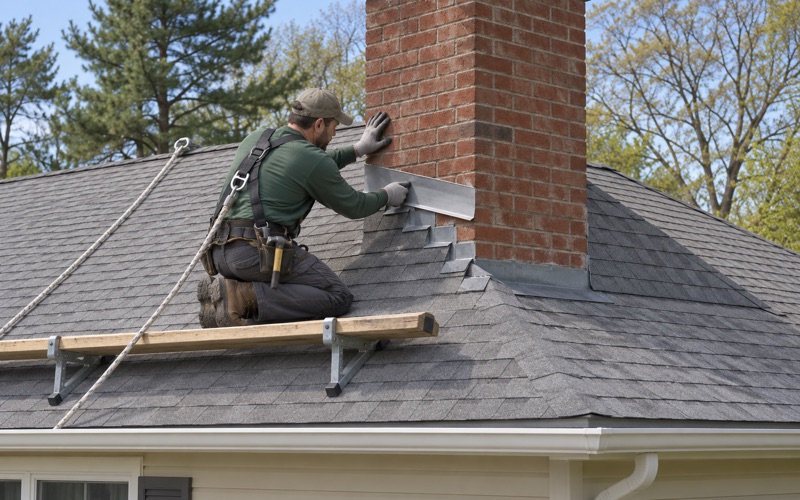
Each of those intersections is a flashing joint. We replace step, counter and chimney flashing with the roof rather than tucking old metal under new shingles, and on painted trim and fascia from before 1978 we follow the EPA lead-safe work rule.
Three- and Four-Family Buildings and Attached Homes
Once a building holds three or more units, or shares a wall with the house next door, the ordinary-maintenance exemption no longer reaches its roof covering. A re-roof on one of those buildings is construction-permit work, filed with the Asbury Park Construction Department at 1 Municipal Plaza, 2nd Floor North. The office is open Monday through Friday from 7:30 a.m. to 4 p.m. and takes inspection requests through an online portal.
Three- and Four-Unit Buildings
The census counts 909 units in three- and four-unit buildings in Asbury Park, about 10.5 percent of the city’s housing. Renters occupy 726 of the 758 occupied units in that group, so nearly every occupied apartment in these buildings is rented rather than lived in by its owner.
For a landlord, that changes the planning. We build the permit and its inspections into the schedule from the start, and we plan the tear-off around occupied apartments: which units sit under the work area, where debris comes down, and how the building stays dry overnight.
Attached Homes and Rows
The city also has 615 attached single-family homes by the same count. A townhouse or row home holds one household, but it is not detached, so its roof covering falls outside the exemption too. The roof plane often runs straight across the party walls, which makes the line between one owner’s roof and the neighbor’s a practical question as well as a legal one.
Where there is an association, we check its documents to see who holds the roof before we write any estimate. Where there is none, we talk with you about how the new roof will tie into the neighbor’s at the party wall, and we write that detail into the scope.
Larger Buildings
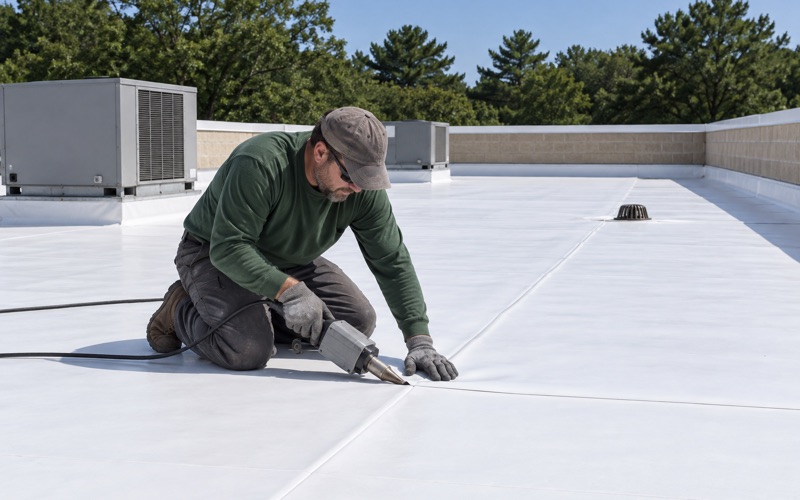
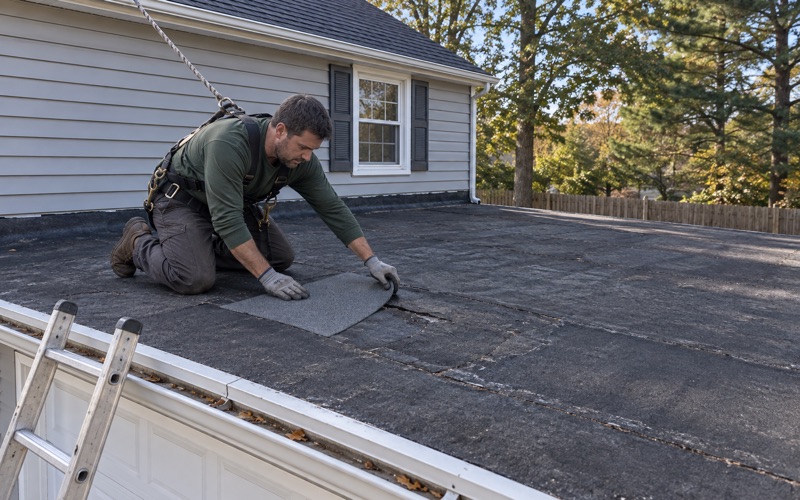
Just under half of Asbury Park’s housing units, 4,289 of them, are in buildings of five or more. Those roofs are often low-slope systems such as EPDM, TPO or torch-down modified bitumen rather than shingles, and like the smaller multifamily buildings they need a construction permit for a re-roof.
We write scopes for those roofs the same way we write them for houses. Tear-off, decking, insulation or underlayment, flashing, drainage and edge metal each get their own line, so a board or an owner can compare bids item by item.
The Multiple-Dwelling Rule for Roofs Over Three or More Units
A building with three or more units in New Jersey also answers to the state’s multiple-dwelling regulations. N.J.A.C. 5:10-7.4 requires that “All exterior walls, roofs, windows, window frames, doors, door frames” and other structural parts be maintained so that they keep water out.
The rule goes further than a general duty. It says “Damaged or badly worn material shall be repaired or replaced” and that “places showing signs of rot, leakage, deterioration or corrosion shall be treated or restored.” For the owner of a three-family, that turns a slow leak from a deferred item into a maintenance obligation under state rules.
What That Means for Repair Decisions
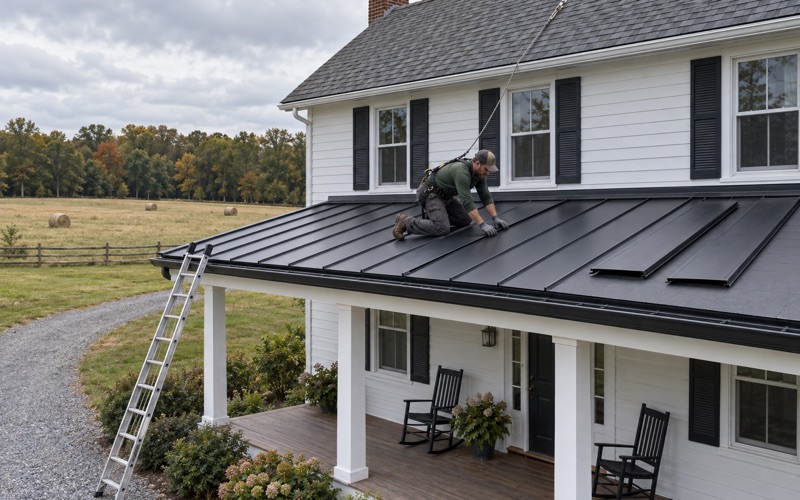
Because the rule is written around keeping water out, our first visit to a multifamily roof is diagnostic. We go into the attic or the space above the top-floor ceiling as well as onto the roof, trace the water to where it actually enters, and only then price anything.
Often the honest answer is a targeted repair: a failed pipe boot, open step flashing at a dormer, a worn valley. When the roof is past repair, we say so plainly and explain why before replacement is put on the table.
Ventilation and the Top-Floor Unit
In a small multifamily building, the top-floor apartment sits closest to the roof deck. A roof that cannot breathe ages from underneath, so on every replacement we check the attic ventilation and balance ridge vent exhaust against soffit intake.
That check matters to tenants as well as to the roof. A poorly vented attic tends to show up first as summer heat in the top unit and moisture under the deck in winter, well before the shingles show it.
Storms and the Records Owners Keep
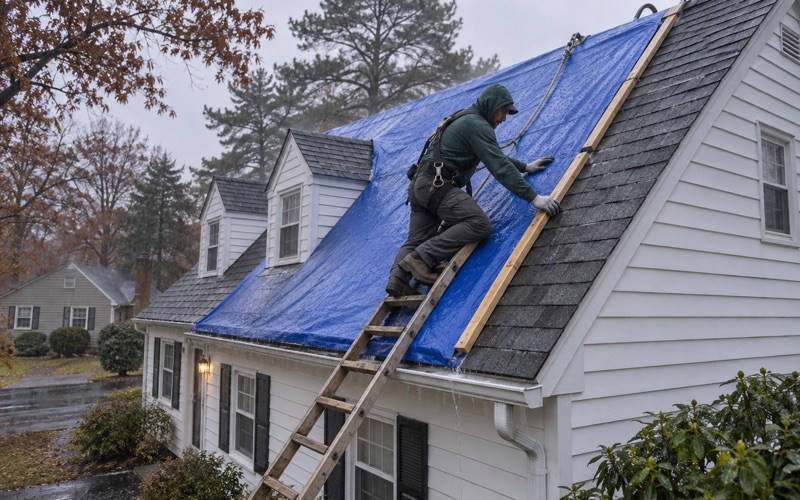
Asbury Park fronts the Atlantic and sits in the National Weather Service’s Eastern Monmouth forecast zone, covered by the Mount Holly office. After a wind storm we put tarps and temporary repairs on the same day where we can, photographing the damage before anything is moved.
Those photos and a written damage report go to the owner for their own insurance claim, and we will meet the adjuster on site when asked. For a landlord with tenants to answer to, a dated record of what was found and what was fixed is worth keeping.
Contracts Written to New Jersey Rules
Every contract we write follows New Jersey’s home improvement rules, including the three-business-day cancellation notice. Whether the building is a detached two-family that needs no permit or a four-family that does, the written scope states which side of the line the job falls on.
Owners selling a property can also ask for a written roof condition report to hand to the buyer’s inspector. Because the permit question here turns on the type of building, that report names the building type alongside what the roof needs.
- 20+ Years on Monmouth County Roofs
- Line-Item Written Estimates
- Same-Day Storm Tarping